
Before approving outdoor excavation for crawl-space drainage in Evansville, check whether the work area has Jacobsville soil-sampling or cleanup records. If the address may be within EPA’s project area, clarify its status and the proposed digging with the agency before a contractor disturbs soil. The useful question is which ground the project will touch, not simply whether the home has a wet crawl space.
Why this matters beyond the Jacobsville neighborhood
EPA’s Jacobsville Neighborhood Soil Contamination site profile describes a 4.5-square-mile area that includes Jacobsville and 12 other Evansville neighborhoods. The program concerns residential soil contaminated with lead and arsenic. Its name should not be used as a shortcut for deciding whether a particular parcel is included.
Start with EPA’s neighborhood boundary map and then confirm your address with the current site contacts. Being within a mapped area does not by itself establish your property’s soil results, cleanup status or the condition of soil beneath the house.
EPA’s March 31, 2025 update named planned yard work in or near Ballard, Bayard Park, Culver, Fulton Terrace, Haynie’s Corner, Jacobsville, Jimtown and Riverside. That dated announcement provides context; it does not establish a current appointment or promise cleanup for a particular address.
There is a specific EPA warning about digging
The September 2009 Record of Decision, Appendix A, addresses homeowners planning work that removes known contaminated soil. EPA says that where it has tested soil and determined excavation is needed under the Superfund program, the homeowner should contact its remedial project manager before digging. The response also raises postponing that work until contaminated-soil removal is complete.
That is a historical project document, so use the current site contacts to confirm how it applies to your property and proposed work now. Do not use an old cleanup letter, a neighbor’s result or a contractor’s visual impression as permission to move soil from a different part of the lot.
Put the drainage proposal on a simple site sketch
A crawl-space job can extend into the yard through an exterior drain, a sump discharge trench, foundation access or regrading. Our editorial planning recommendation is to ask every bidder to mark:
- The crawl-space entry and all proposed outdoor digging
- The approximate route, length and proposed depth of each trench
- The intended water outlet and the evidence that it is suitable
- Where workers and machines will travel
- Where excavated soil would be placed, moved or taken off site
- Any areas where previous soil replacement or restoration is documented
Send that same sketch with your records questions. A request about a short discharge trench beside the house is more useful than asking whether all drainage work is allowed. Have the drainage professional separately assess the water source and outlet; soil records do not diagnose why the crawl space is wet.
Our drainage-options guide explains the different purposes of exterior drainage, interior collection and sump systems. Choosing an interior system does not automatically remove the records question if its discharge line still requires yard excavation.
Request records that match the proposed work area
EPA’s site profile says sampling results are sent directly to property owners. Look for the original results and later cleanup correspondence, rather than relying on a recollection that someone once tested the yard.
Before scheduling excavation, ask the agency or an appropriately qualified environmental professional:
- Was this address sampled, and which portions of the property do those results describe?
- Was cleanup completed, pending or not required under the decision communicated to the owner?
- Do the available records cover the location and depth of the proposed work?
- Could the work affect replaced soil, restored surfaces or any remaining site-management requirements?
- Who should determine soil handling, transport and disposal if the proposed digging encounters a concern?
Keep the answers with the site sketch and estimate. If the answer is still unknown, ask the contractor to identify the excavation-dependent portion of the quote and the condition that must be resolved before it starts. Avoid a schedule that assumes an agency response or cleanup date you have not received.
Keep moisture findings separate from environmental findings
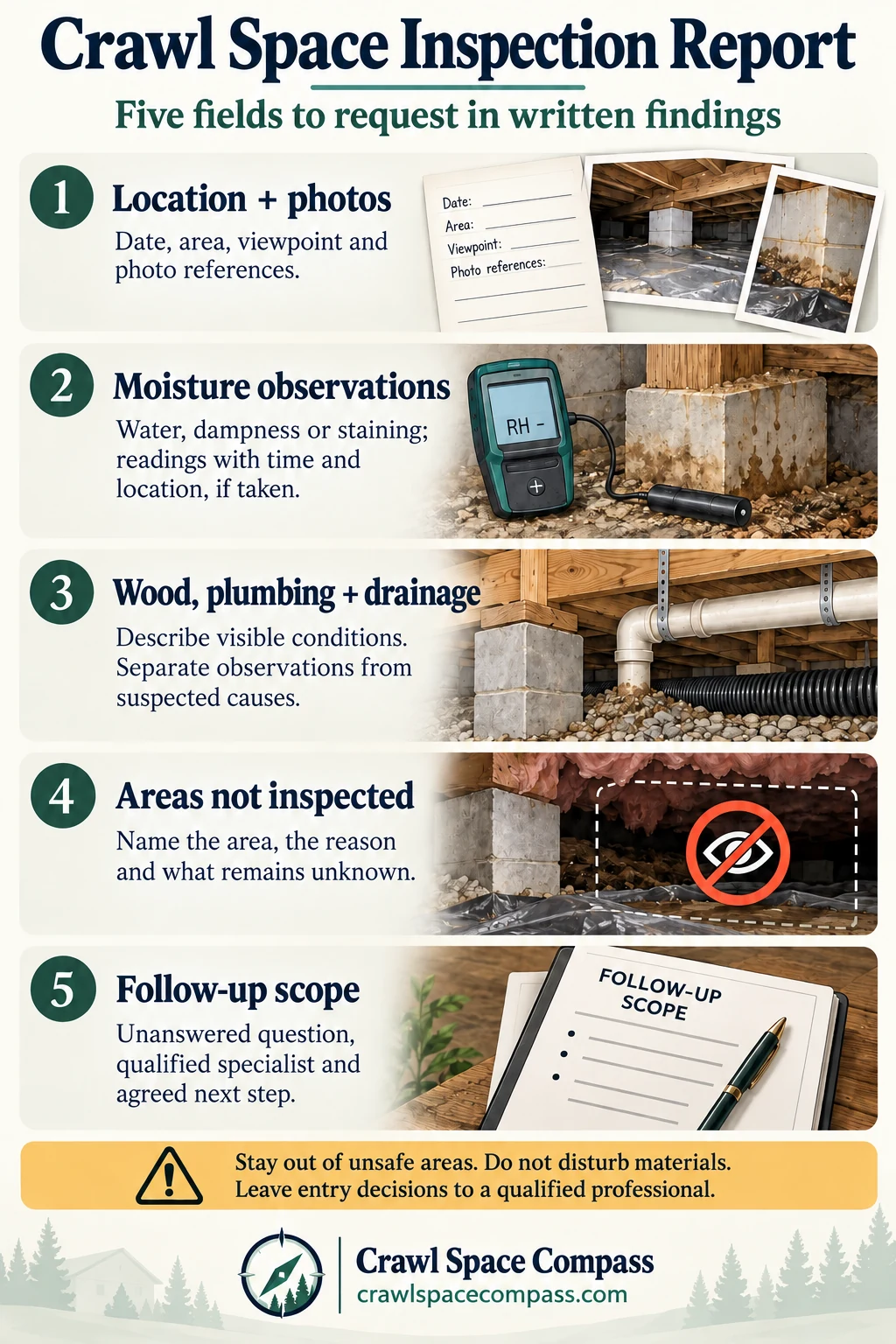
The graphic in text: Request the date, area, viewpoint and photo references; moisture observations and the time and location of any readings; visible wood, plumbing and drainage conditions with suspected causes identified separately; areas not inspected and why; and the unanswered question, qualified specialist and next step. Stay out of unsafe areas, do not disturb materials and leave entry decisions to a qualified professional.
Use the full inspection checklist for the moisture record. A crawl-space inspection photograph cannot establish lead or arsenic concentrations. Keep environmental conclusions tied to the appropriate sampling and professional review.
Do not turn an uncertain soil issue into a cleanup experiment
EPA’s lead-in-soil guidance explains that contaminated soil can be carried indoors on shoes, clothing, pets and other objects. It recommends measures such as removing shoes and using entry mats to reduce tracking.
Pending a project-specific response, avoid disturbing suspect soil or carrying it through the home. Ask the responsible professionals to address work-area access, dust, equipment routes, soil handling and restoration. This guide does not provide a DIY sampling, excavation or disposal procedure.
Use local profiles for the drainage portion
The Evansville directory includes ACCA Basement Systems and Water Fire Mold Experts. Use their profiles to begin comparing crawl-space scopes and confirm current service coverage directly.
Directory inclusion does not establish environmental-remediation qualifications, EPA affiliation or authorization to handle contaminated soil. Keep any environmental assessment or soil-remediation assignment separate and verify the qualifications needed for that work.
Does a new vapor barrier resolve the soil-records question?
No. A moisture-control proposal does not establish the environmental condition of the soil or address the consequences of outdoor digging. Resolve the specific records and work-area questions before approving that excavation scope.
Sources checked October 15, 2026. EPA’s historical documents and dated updates are identified above; confirm current property status and project instructions directly.