
Before crawl-space repairs disturb painted materials in an older Louisville home, identify which surfaces the work will touch and arrange the appropriate lead-safe assessment and work practices. A repair estimate should explain who handles that question before demolition, cutting or surface preparation begins.
This guide is for Louisville and Jefferson County, Kentucky homeowners planning repairs around an existing crawl space. It does not determine whether paint contains lead, whether a specific project falls under a rule, or whether a particular company holds a lead-related credential. Leave unsafe entry and material sampling to qualified professionals.
Start with the repair route and the painted surfaces
EPA’s renovation guidance for homeowners explains that pre-1978 homes are more likely to contain lead-based paint and that work such as sanding or cutting can release hazardous dust and chips. EPA recommends hiring a contractor trained and certified in lead-safe practices for renovation work in these homes.
That is a reason to ask a focused question about the proposed work. It does not establish that every exposed joist is painted or that every older crawl space contains lead. Ask the contractor to identify the exact components involved: an access door and frame, painted masonry, coated wood, a porch-floor assembly, or painted interior trim that must be removed to reach a repair.
Include the route workers and materials will take. A repair approached through an interior hatch may involve different painted surfaces from the same repair reached through an exterior opening. Record areas that were not visible during the estimate and how the proposal will change if those surfaces need attention.
Check Louisville’s current program notice before relying on assistance
At the October 15, 2026 review, the Lead-Safe Louisville page displayed a notice saying new applications have not been accepted since December 5, 2025. The city also describes the program’s lead-hazard work in owner-occupied and rental housing. Its historical program description does not establish that funding is currently available for your project.
Use the current page or its listed office number, 502-574-5850, to ask about status and available guidance. Do not schedule a repair on the assumption that an older brochure or a contractor’s recollection means the program will pay. If assistance becomes available, ask the program which assessment, contractor selection and work-order steps must happen before work starts.
A homeowner can still prepare a repair brief while checking the program: the approximate construction date, existing reports, proposed disturbed surfaces and photographs already available. Keep personal eligibility information for the program’s official process; the crawl-space quote only needs the project information relevant to that contractor’s work.
Match the professional to the question
The Kentucky Environmental Lead Program provides information about lead-based-paint services, certification and company listings. It separately identifies renovation, repair and painting as a program administered by EPA. Use those official resources to check the credential relevant to the service being offered.
EPA distinguishes lead abatement from renovation, repair and painting. A project intended to address an existing lead hazard has a different purpose and certification path from ordinary repair work that disturbs paint along the way. Ask which service you are buying and who has responsibility for it.
- Paint or hazard question: Who will determine what evaluation is appropriate, which surfaces are covered and what the results mean for the proposed repair?
- Repair question: Who specifies the wood, support or moisture work and identifies surfaces that will be disturbed?
- Work-practice question: Who manages the applicable containment, occupant protection, cleanup and completion checks?
- Coordination question: If different firms are involved, who confirms the work area is ready for the next crew?
A general contractor license, an insurance certificate and a directory listing do not answer all four questions. Request the relevant firm and individual credential information, then check it through the responsible official program. This guide has not verified lead-related credentials for any directory provider.
Put the lead-safe handoff into the repair scope
Use a marked photograph or simple location list to connect the paint question with the repair. For example: “Replace the rear access-door frame; existing coating has not been evaluated; confirm the assessment and work-practice plan before removal.” This is a hypothetical planning record, not a diagnosis.
Ask the written proposal to identify included assessment, protected areas, debris handling, cleanup responsibility and the evidence provided at completion. If the scope excludes lead-related work, name the person who will arrange it and the point at which the repair pauses. Avoid an open-ended instruction to “deal with old paint as needed” when the price, responsible firm and sequence are undecided.
For floor repairs, also ask whether work will open a path into the occupied rooms above. Have the professionals explain access restrictions and how occupants will be told when a work area can be used again. Do not move barriers, handle removed materials or enter the work area to take progress photographs.
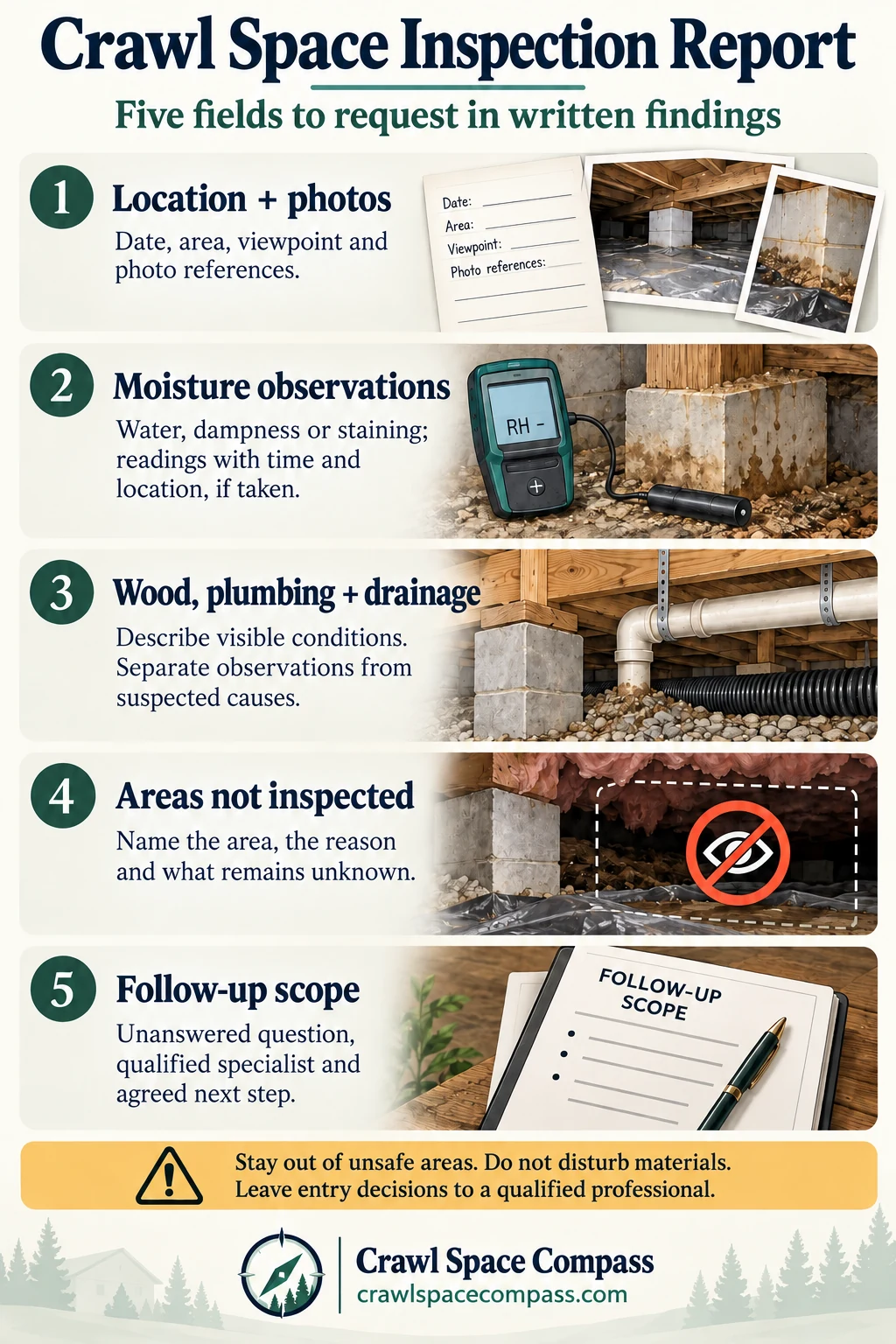
Inspection report graphic, in text
Crawl Space Inspection Report. Five fields to request in written findings:
- Location + photos: Date, area, viewpoint and photo references.
- Moisture observations: Water, dampness or staining; readings with time and location, if taken.
- Wood, plumbing + drainage: Describe visible conditions. Separate observations from suspected causes.
- Areas not inspected: Name the area, the reason and what remains unknown.
- Follow-up scope: Unanswered question, qualified specialist and agreed next step.
Safety: Stay out of unsafe areas. Do not disturb materials. Leave entry decisions to a qualified professional. Graphic: Crawl Space Compass, crawlspacecompass.com.
Research the crawl-space repair portion locally
The Louisville directory and Kentucky contractor guide provide starting points for building and moisture work. The KCS Foundation and Waterproofing Specialists profile links to company-reported crawl-space repair, including floor stabilization and wood repair. The Aqua Lock profile covers company-reported crawl-space services, including floor-joist repair, with a Jeffersontown contact location and Louisville service statements.
These are research options for the repair portion, with no endorsement or claim that either company performs lead assessment or abatement. Confirm your address, proposed repair and current qualifications directly. Use the structural-repair guide to organize the separate building questions. If water is also unresolved, the Louisville drainage-responsibility guide helps prepare that discussion.
Common questions
Does a newer coat of paint settle the lead question?
Do not treat appearance or a recent repaint as an evaluation of the underlying materials. Tell the evaluating professional what is known about earlier work and ask which surfaces the findings cover.
Does installing a crawl-space liner count as lead abatement?
A crawl-space moisture-control proposal does not by itself establish a lead-hazard treatment plan. Ask the appropriately qualified professional to explain any lead-related scope separately and document the intended result.
What should I keep when the repair is complete?
Keep the assessment findings, relevant credential details, final repair scope, photographs, cleanup or completion records supplied, and any remaining restrictions. Label unexamined areas clearly so a future contractor does not mistake a limited review for a whole-property finding.
Source review: October 15, 2026. The Louisville program notice was checked in a current indexed official-page extract; direct retrieval returned an access error. Kentucky and EPA resources and the two companies’ own service pages were reviewed. Confirm current program status and project-specific requirements with the responsible office.