
Before changing a Dayton crawl space that has a vapor-intrusion system or an environmental-site notice, identify the site contact and ask how the proposed work should be coordinated. A moisture-control estimate should record existing equipment, monitoring access and unresolved environmental questions before anyone removes a liner, seals openings or changes equipment.
This guide helps Dayton, Ohio, homeowners organize that conversation. It does not determine whether a property is contaminated, interpret a laboratory result or design a mitigation system. Collect documents and photographs already available from safe locations. Do not enter an unsafe crawl space, handle unknown substances or disturb environmental equipment to gather information.
Start with the correct Dayton-area site record
The EPA’s Dayton environmental-projects page distinguishes several cleanup sites and their locations. Behr Dayton Thermal System VOC Plume is in Dayton; Valley Pike VOCs is in Riverside. A Dayton mailing address, a neighborhood name or proximity to a map symbol does not establish which project applies to a property. Use the exact address when asking the relevant site team.
For Behr Dayton, the EPA site profile provides the project identity and current contact links. Its Health & Environment page links an Area of Potential Concern map and gives a sampling inquiry route for properties potentially affected by vapor intrusion. Treat the map as a reason to ask an address-specific question, rather than proof of a condition inside your home.
Keep a dated copy of the source you consulted. If an old letter names a different contact, use the current site profile to confirm who handles the property now. A historical sampling report and a current maintenance record answer different questions; retain both.
Separate chemical-vapor questions from ordinary moisture work
EPA explains vapor intrusion as vapor-forming chemicals moving from a subsurface source into a building. That is a different assessment from measuring crawl-space humidity, tracing rainwater or checking for visible moisture damage. A humidity reading or an ordinary crawl-space inspection is not a site-specific vapor-intrusion determination.
Tell each bidder what you are actually asking them to do. One assignment might be to document standing water and damaged insulation. Another might be to coordinate a proposed liner replacement with the environmental system’s responsible technician. Do not let one line saying “vapor barrier” stand in for both assignments. Ask the site team which records or specialist assessment, if any, are needed before the planned alterations.
Our encapsulation and ground-liner comparison explains ordinary moisture-control scope. It should not be used to select a chemical-vapor remedy or to replace the environmental site’s instructions.
If a vapor-intrusion system is already installed
EPA’s Behr Dayton property guidance says an existing vapor-intrusion mitigation system should remain operating and that technicians need access to inspect it. Bring that requirement into the repair discussion before scheduling work. Do not switch off, remove, reroute or cover the system as part of a routine cleanup or encapsulation job.
Ask the responsible site contact or system technician to review the proposed changes. EPA’s 2015 vapor-intrusion technical guide, section 8.3, discusses maintenance review of system configuration, building changes and membrane condition. For a homeowner, the useful outcome is a written coordination plan, with the technical evaluation left to the responsible professionals.
- Identify the system: Gather its label, installation paperwork, service contact and available maintenance history. Ask the technician to identify components the contractor must avoid.
- Describe the alteration: Mark proposed liner removal, access work, drainage changes and equipment work on the contractor’s scope. Explain what will be covered or disturbed.
- Assign coordination: Name who will consult the site team, arrange technician access and record any requirements before work starts.
- Define the handoff: Ask what post-work review or documentation the system technician needs and who will arrange it. Keep unresolved items visible rather than treating a contractor’s cleanup photo as environmental clearance.
Build one project record with separate responsibilities
A simple project record prevents the environmental and moisture-repair discussions from becoming disconnected. Use the same property address and component descriptions in every document. Ask the crawl-space inspector to distinguish observed conditions, inaccessible areas, proposed work and matters referred to the site team.
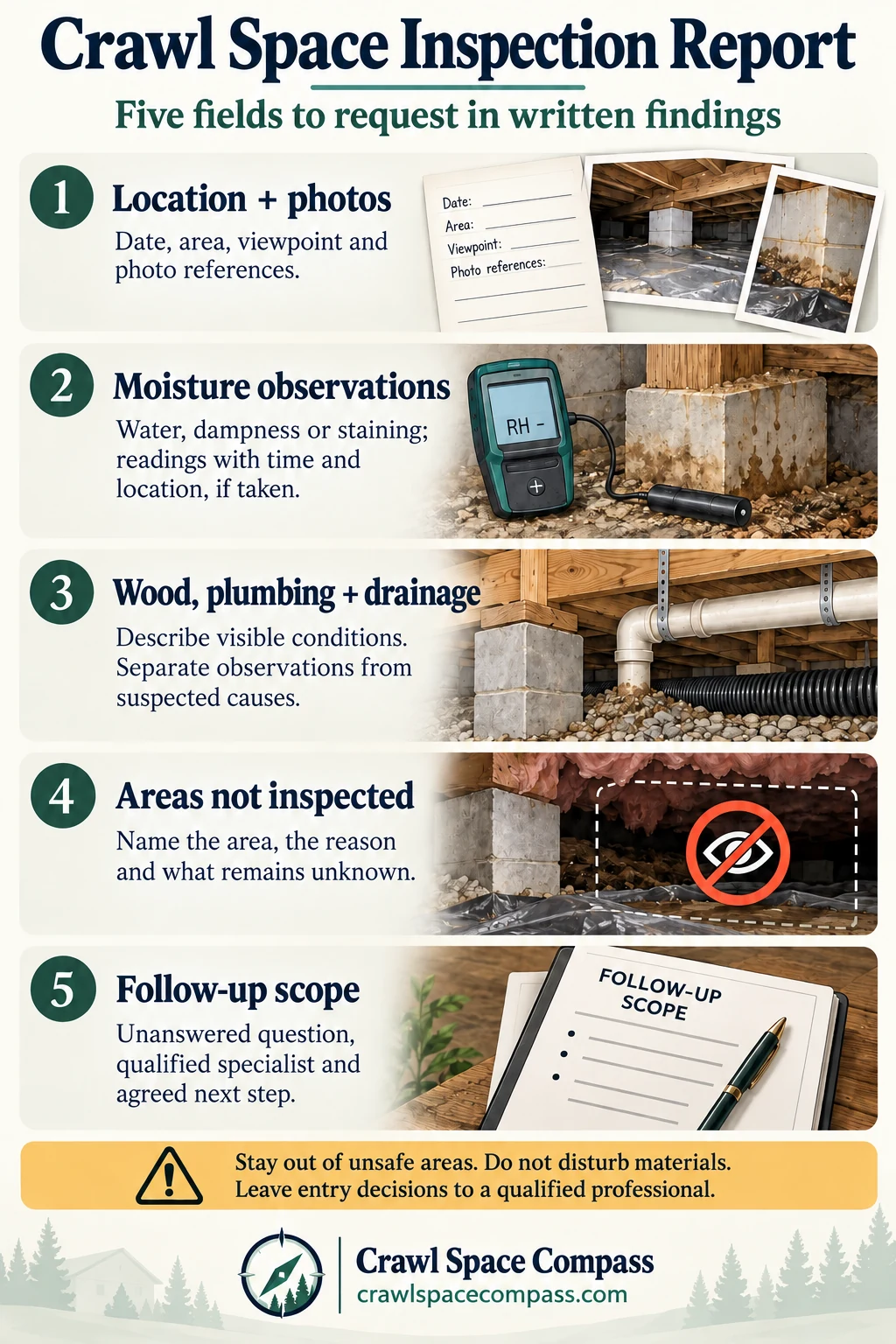
Text equivalent of the graphic: Crawl Space Inspection Report: five fields to request in written findings. (1) Location and photos: date, area, viewpoint and photo references. (2) Moisture observations: water, dampness or staining; readings with time and location, if taken. (3) Wood, plumbing and drainage: describe visible conditions and separate observations from suspected causes. (4) Areas not inspected: name the area, the reason and what remains unknown. (5) Follow-up scope: unanswered question, qualified specialist and agreed next step. Stay out of unsafe areas. Do not disturb materials. Leave entry decisions to a qualified professional. For this project, attach the environmental-site correspondence separately and identify the person responsible for each unresolved question.
Before comparing totals, request three clearly labeled parts: the observed moisture or repair problem, the proposed ordinary crawl-space work, and any environmental coordination still pending. Ask whether the price assumes a liner or system can be moved. If the assumption has not been reviewed, have it marked as unresolved rather than silently included in the base price.
Use directory profiles for the ordinary crawl-space scope
The Ohio directory’s Southwest Ohio section provides regional starting points for Dayton inquiries. Existing profiles include Healthy Basement Concepts, whose company website lists Dayton service and crawl-space repair, and Jaco Waterproofing, whose company information identifies Dayton among its service areas.
These are starting points for discussing separately identified repair or moisture-control work. We have not verified either company’s qualifications for chemical-vapor assessment or site-specific mitigation. Confirm the property address, requested service and environmental coordination directly. A listed contact city or advertised service area is not proof of a Dayton office, availability or specialist authorization.
Dayton planning questions
Does being near the Behr Dayton site mean my crawl space is contaminated?
No property determination is made here. Use the official site record and ask the site team whether the address needs further review. A neighborhood label or map alone cannot substitute for that process.
Can encapsulation replace an existing mitigation system?
Do not treat a moisture-work proposal as permission to replace or alter that system. Have the responsible environmental professionals review the actual proposal and preserve their operating instructions.
What should I have before the crawl-space work begins?
A defined repair scope, the appropriate environmental contact, a record of existing systems and any needed coordination instructions. If a question affects the planned work, resolve it with the responsible party before that portion proceeds.
Sources checked October 15, 2026. EPA’s Dayton overview displays an August 3, 2026 update; the general vapor-intrusion page displays August 21, 2026. The Behr site pages were retrieved during this review, but no new property sampling was performed. Site records and contacts can change; recheck the official pages for your project.