
Before encapsulating a Charlotte crawl space that contains a gas furnace or water heater, have a qualified professional identify the appliance’s combustion-air source and review the proposed enclosure. Put that review, any needed appliance work and the final safety checks in the project scope before ordinary vents are sealed.
This guide is for planning work at Charlotte and Mecklenburg County homes. It does not determine whether a particular installation complies with code. For an address outside Mecklenburg County, confirm the responsible inspection department.
Start with the appliance, not its age or efficiency label
The U.S. Department of Energy’s crawl-space retrofit guidance says to identify venting and combustion-air sources before air-sealing work. Some fuel-burning appliances use air from the space around them; direct-vent equipment brings combustion air from outdoors through its designed connection.
Ask the HVAC professional to document the make, model, fuel, vent arrangement and air source for each furnace, water heater or other fuel-burning appliance affected by the work. An installer should verify the actual configuration against the manufacturer’s instructions. A newer appliance or a high-efficiency label alone does not answer how this installation obtains air.
Do not disconnect a vent, modify a burner, add an air opening or block an existing opening to test a theory. Leave appliance inspection, combustion testing and changes to qualified professionals.
Bring one coordinated scope to Mecklenburg County
Mecklenburg County Code Enforcement issues building, electrical, plumbing and mechanical permits. Its residential guidance identifies heating-system and electrical-system changes among the work that can require permits even when a project is below the general dollar threshold.
More specifically, the North Carolina Office of State Fire Marshal’s December 2025 closed-crawl-space interpretation says conversion of a conventional vented crawl space to a closed crawl space requires a permit regardless of cost. It explains that the moisture-control methods involve mechanical or electrical changes and describes building, mechanical and applicable electrical inspections within the single permit.
Give the county the complete proposed work: enclosure changes, drying method, appliance work, electrical work and condensate routing. Ask which application and inspection sequence applies to that combined scope. The county’s AccelaMeck guidance provides current residential alteration, trade-permit and inspection resources. Do not assume a general equipment-changeout application covers the entire conversion.
Ask bidders to complete five handoff questions
These are homeowner planning questions, not a combustion-system design:
- Who reviews each appliance? Name the qualified HVAC or home-performance professional and state whether that review is included or separately arranged.
- What changes before sealing? Identify any appliance, venting or combustion-air work, who performs it and who confirms it is ready for the enclosure work.
- What does the drying system change? Identify whether the plan uses a dehumidifier, supply air or exhaust. Have the appliance reviewer consider the actual proposed system and other relevant exhaust equipment.
- What stays accessible? Mark service panels, filters, shutoffs, vent connections and the route needed to remove equipment. Ask how the liner and insulation will accommodate future maintenance.
- Who checks the finished condition? Name the person responsible for post-work appliance checks, required inspections and written closeout records. Include what happens if a result needs correction.
For example, a quote that lists a liner, wall insulation and dehumidifier but says nothing about the existing gas water heater leaves an important coordination question unanswered. Ask for the appliance-review scope before treating that proposal as complete. This is an illustrative comparison, not a finding about any listed company.
Keep the before-and-after appliance record
DOE’s combustion-appliance assessment guidance explains that pressure changes can affect natural-draft equipment. Its workflow includes identifying vent defects, checking draft and carbon monoxide, having qualified technicians address problems and testing appliances again after the upgrade.
Ask what testing is appropriate for your equipment and who is qualified to perform it. Request dated findings, the appliance identification, corrections made and final results. A humidity reading, a photograph of a sealed liner or a working household carbon-monoxide alarm does not replace that professional review. Have the professional also review alarm needs under applicable requirements and manufacturer instructions.
Use the whole-system checklist
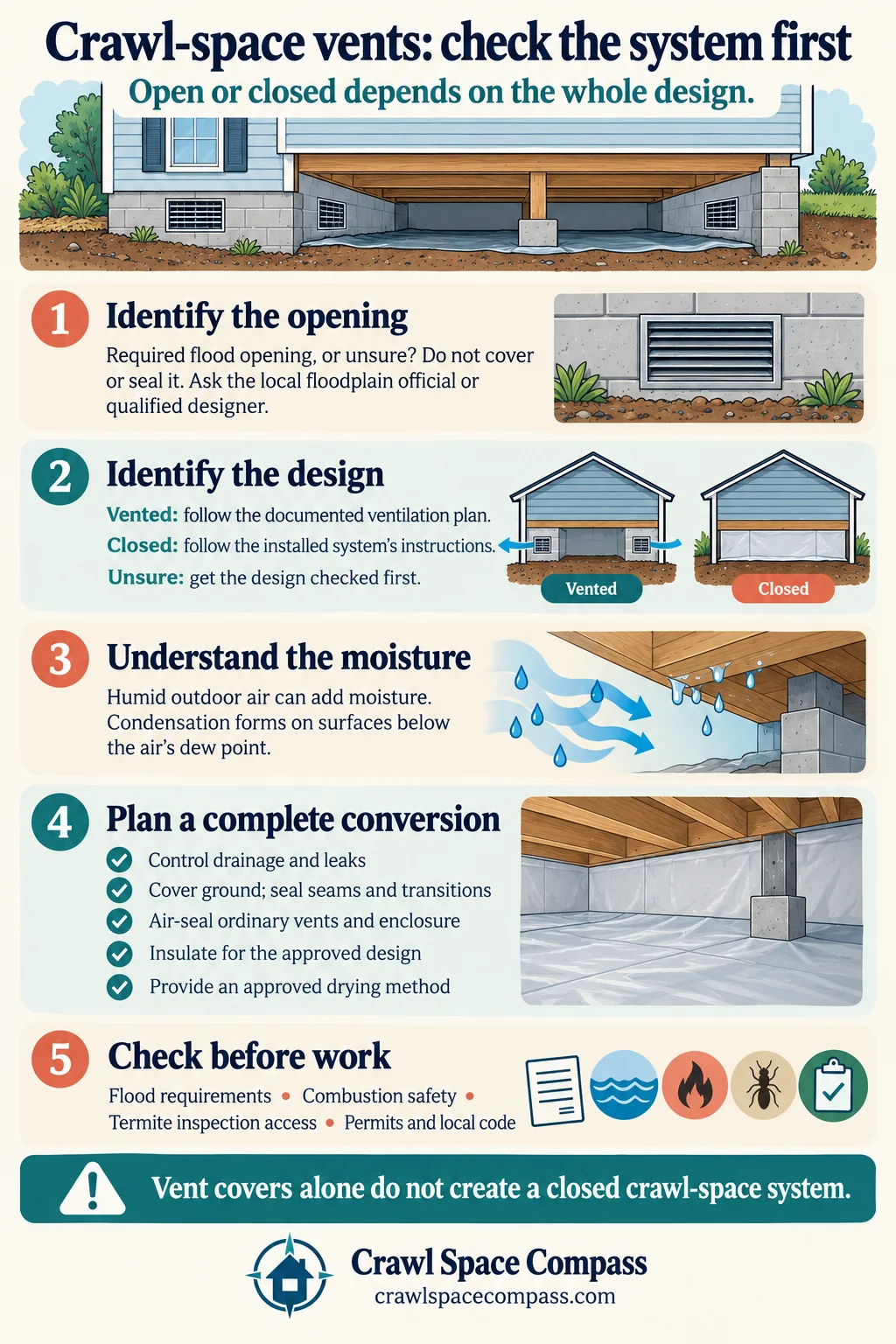
The graphic in text:
- Identify the opening. Do not seal a required flood opening, or an unidentified opening; ask the local floodplain official or qualified designer.
- Identify the design. Follow the documented vented or closed system’s instructions; have an unknown design checked.
- Understand moisture. Humid outdoor air can add moisture, and condensation forms on surfaces below the air’s dew point.
- Plan the complete conversion: drainage and leaks, ground cover and seams, enclosure sealing, appropriate insulation and an approved drying method.
- Review flood requirements, combustion safety, termite inspection access, permits and local code. Vent covers alone do not create a closed system.
Our vent-system guide explains the broader checklist. Use the quote-comparison guide to keep appliance work and exclusions visible beside the enclosure price.
Find local crawl-space bidders and identify the separate specialist
The Charlotte directory includes Moisture Loc, Inc. and Greenserve. Their crawl-space repair and encapsulation pages describe relevant services. Confirm current availability and the exact scope at your address.
A crawl-space listing does not establish that the company performs combustion-safety testing or holds every needed trade credential. Ask whether it coordinates with your HVAC contractor, uses a qualified subcontractor or expects you to arrange the appliance review separately.
Two questions before scheduling
Does a gas appliance automatically rule out encapsulation?
The proposal needs a qualified assessment of the appliance and the resulting space. Do not assume either automatic approval or mandatory replacement from the appliance’s age alone.
What should I keep after the job?
Keep the final scope, applicable permit and inspection records, appliance-review results, equipment instructions and maintenance-access photographs together. That gives the next service technician useful context.
Sources checked October 15, 2026. Requirements and project details should be confirmed with the responsible professionals and Mecklenburg County.