
If a crawl-space dehumidifier in Columbus, Ohio, needs replacement, check its exact model against current recall notices before deciding how to remove it. Then arrange an accepted disposal route. The city’s regular bulk service and its two Waste and Reuse Convenience Centers explicitly exclude dehumidifiers, so setting one beside the trash or driving it to a convenience center is not the right plan.
A useful replacement job includes the old unit’s identity, any recall instructions, safe removal from under the house, refrigerant handling and a documented handoff for the new equipment. This guide helps you ask for those details. It is not a complete recall list or a certification that a particular appliance is safe.
Record the exact unit before it leaves
Use an existing equipment record or have the service professional photograph the rating label during a safe inspection. Capture the brand, complete model number, serial number and manufacture or date code if shown. Keep a wider photograph showing which unit the label belongs to, especially if the property has more than one dehumidifier.
Copy the characters carefully. A suffix, punctuation mark or date range can distinguish an affected product from a different model with similar branding. A receipt can help establish when and where the unit was purchased, but it does not replace the actual equipment label. If the label is unreadable, ask the manufacturer what evidence can identify the appliance.
Do not enter standing water or approach unsafe electrical equipment to obtain a photograph. Ask the appropriate service professional to handle an inaccessible, hardwired or damaged installation. The purpose of this inventory is to support the service decision, not to create another exposure while collecting details.
Check the notice for the model, not just the brand
Start at the U.S. Consumer Product Safety Commission recall search and search the product type and manufacturer. Compare the notice’s model table and any date or serial-number conditions with your records. Read the remedy and consumer-contact sections of the matching notice rather than relying on an old retailer email or a search-result headline.
For example, CPSC’s August 2023 Gree recall covers specified models sold under several brand names and instructs affected consumers to stop use and unplug them. On the date reviewed for this guide, its consumer-contact section directed readers to a waitlist. Follow the current notice for the applicable remedy process; do not assume an old refund contact or response timetable remains current.
The separate New Widetech recall notice illustrates why the full identification matters: it includes multiple brands and model information, with manufacture-timeframe and serial-number information added to the notice. These examples are starting points, not an exhaustive list of affected dehumidifiers.
If the unit matches a recall, follow its stop-use instruction and ask the manufacturer what records or photographs are needed before disposal. Do not keep operating a recalled unit merely while waiting for a replacement. Have a professional plan the temporary moisture-management arrangements. Keep the recall correspondence so a removal crew knows what has already been documented.
Know the two Columbus routes that exclude it
The city’s Bulk Collection page lists dehumidifiers among refrigerated appliances it does not collect. Its accepted appliance examples are non-refrigerant items such as washing machines and dishwashers. The page directs residents with excluded items to a private hauler. A scheduled bulk appointment for other household items does not establish acceptance of a dehumidifier.
The Waste and Reuse Convenience Centers page also lists dehumidifiers as unacceptable. This applies to the city facilities at 2100 Alum Creek Drive and 1550 Georgesville Road. The same page says the centers serve Columbus residents with material generated at their residences and are not available to commercial businesses. Do not assume a contractor can use a resident drop-off option for a job load.
For a question about city collection, the published contact is 614-645-3111. Describe the item as a dehumidifier rather than simply “scrap metal” or “an appliance.” If the home is outside Columbus’s collection service, check that municipality or hauler’s rules instead of applying the Columbus policy to every Franklin County address.
The city’s recycling guidance links to SWACO’s Recycle Right search tool. Use it as another starting point for finding a receiving facility, then confirm acceptance directly. A general electronics, household-hazardous-waste or scrap-metal listing is not confirmation that a facility accepts this refrigerant-containing appliance.
Ask who handles refrigerant and the final destination
EPA’s consumer appliance-disposal guidance recommends checking municipal, retailer, utility or recycler arrangements and their eligibility requirements. It explains that the final disposer is responsible for refrigerant recovery. Where another entity has already recovered it, EPA describes a signed statement identifying the recovery person and date; it does not require a disposal sticker.
Ask the proposed hauler or installer whether they accept the unit intact, where it will go and who handles refrigerant recovery. Do not puncture tubing, open the refrigeration circuit or attempt to empty it for collection. Ask what receipt or other documentation they provide. A vague promise to “take away the old one” leaves those details unanswered.
Give the crew an accurate description of access: entrance dimensions, steps, distance under the house and whether the unit is connected to ducts, permanent wiring or a drain. Ask whether removal includes disconnecting those services and restoring any disturbed liner or access opening. Have the responsible trade handle work outside the hauler’s scope.
Make the replacement quote cover the whole job
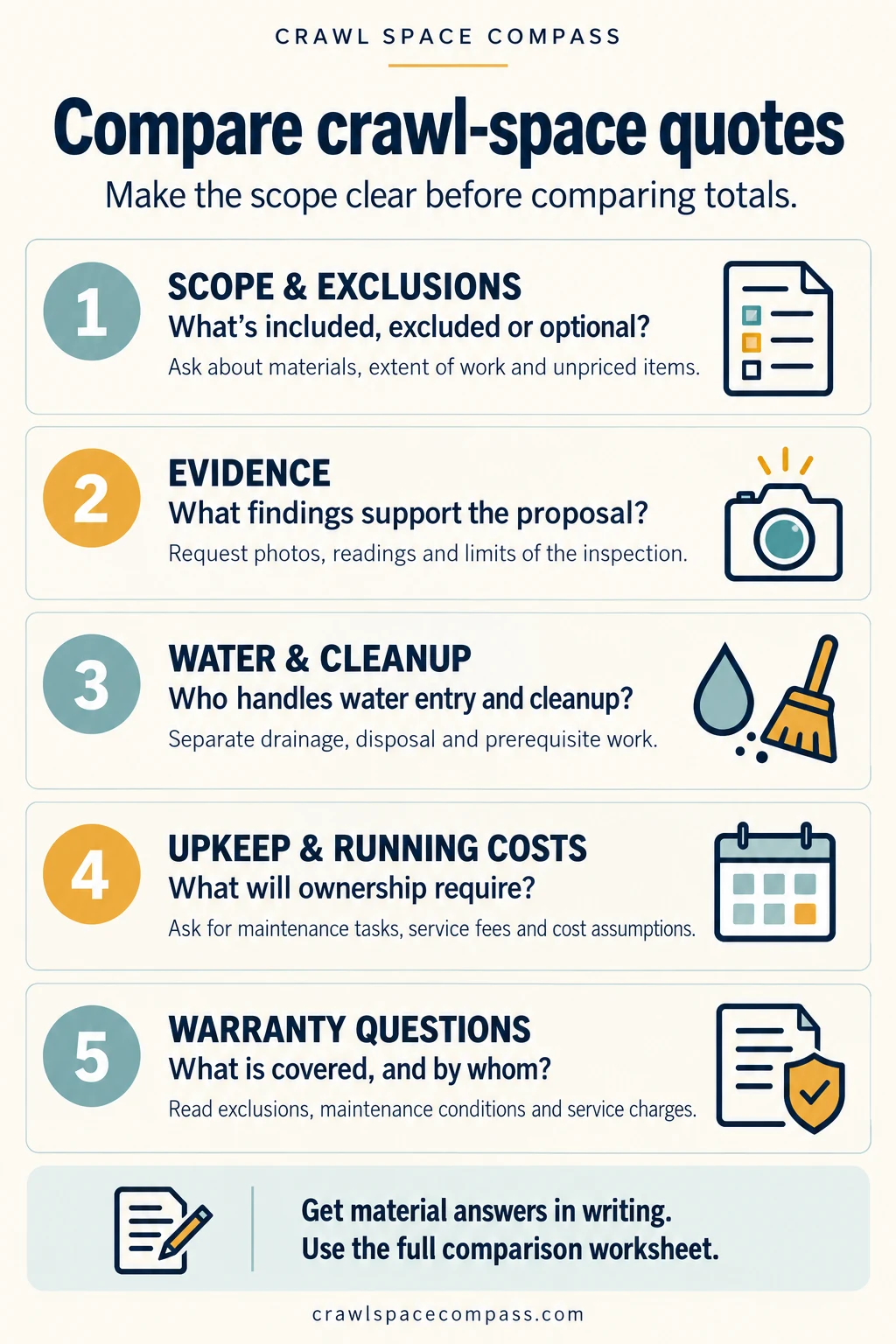
Use the crawl-space quote comparison checklist to separate the new equipment from removal and disposal. Ask for:
- The proposed model, its installation instructions and why it fits the inspected crawl space.
- The findings about existing moisture and any separate water-entry work still needed.
- Who handles wiring, drainage, ducts and removal of the old unit.
- The disposal destination or receiving arrangement, with all pickup and handling charges identified.
- The startup checks, owner instructions and maintenance access included in the installation.
- The warranty provider, exclusions and any separate service or labor charges.
For crawl-space assessment, review the Quality Basement Solutions and Mid-State Basement Systems directory profiles. Confirm the property served and the services offered directly. Directory inclusion does not verify recall-processing services, refrigerant handling or disposal acceptance.
Does an older unit automatically need replacement?
Age alone is not a recall determination. Establish the exact model and applicable notice, then ask a qualified service professional about condition and suitability. Do not treat the absence of a match in one example recall as a complete safety assessment.
What should stay in the home-maintenance file?
Keep the old identification photographs, recall correspondence if applicable, removal receipt, new model and serial number, installation instructions and startup record. This makes the next service visit and future recall check much easier.
Source review: October 14, 2026. City, EPA and recycling-tool pages were retrieved directly. The CPSC examples are 2021 and 2023 notices reviewed through current indexed extracts; direct retrieval of those two notice pages was unavailable. They are not a complete recall inventory. Confirm the applicable remedy and receiving facility’s rules before arranging removal.