
Crawl Space Dehumidifier Guide
Last reviewed: October 7, 2026
Quick links: Sizing · Installation · Humidity settings · Installer checklist · FAQs
When a crawl space dehumidifier helps
A crawl space dehumidifier removes water vapor from the air and drains the collected water away. It can provide active humidity control when the crawl-space design calls for it. Before buying one, identify how moisture is entering, confirm that the equipment suits the environment, and plan its drainage and maintenance.
The useful buying question is: “What moisture load will this unit handle after the water and enclosure problems are addressed?” A larger machine alone cannot repair a leaking pipe, redirect runoff or replace a failed drainage system.
Plan the system, then choose the unit
Use this five-part crawl space dehumidifier checklist to review the whole installation. It is a planning aid, not an installation diagram or a substitute for the selected model’s manual.
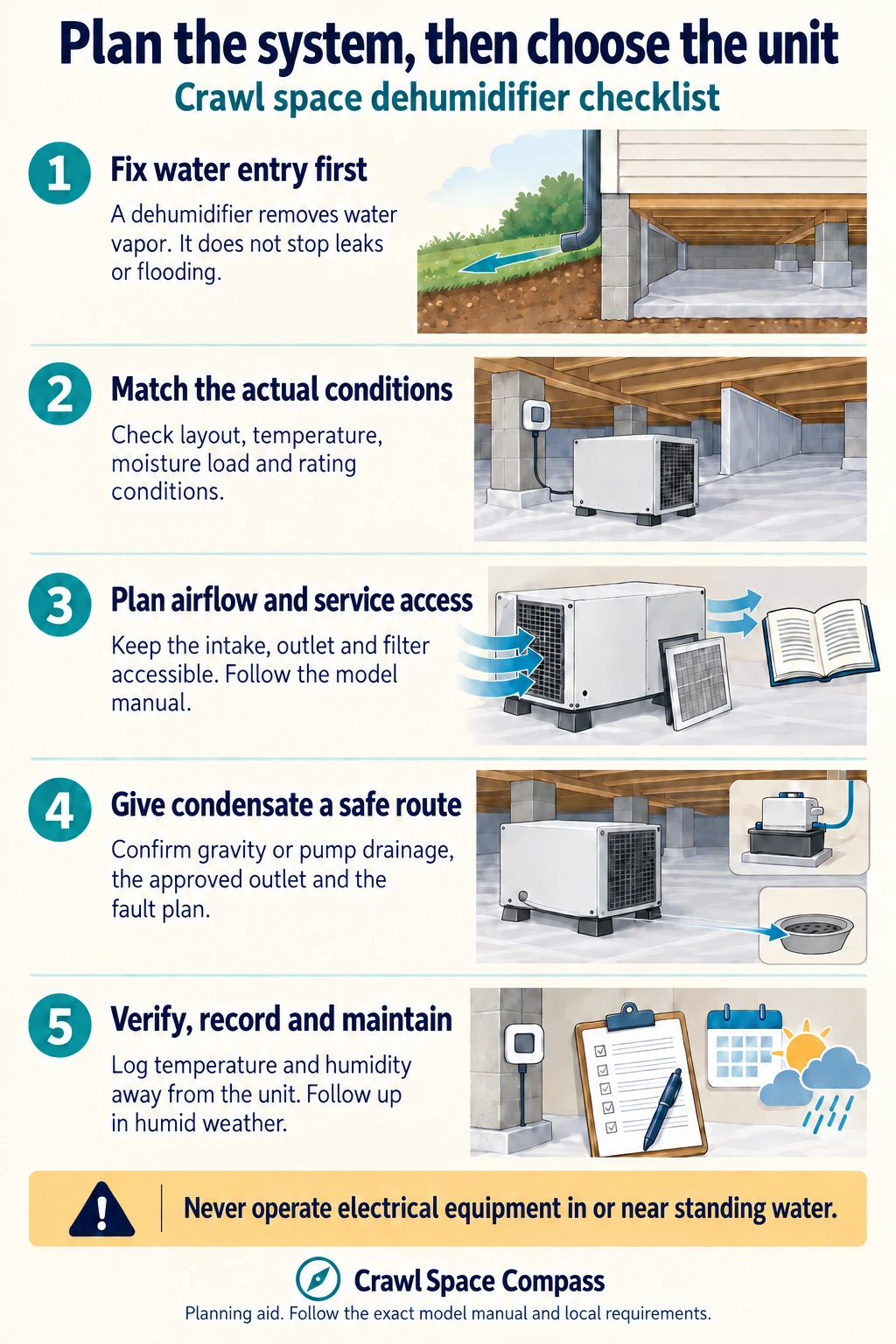
Read the infographic as text
- Fix water entry first. A dehumidifier removes water vapor. It does not stop leaks or flooding.
- Match the actual conditions. Check layout, temperature, moisture load and rating conditions.
- Plan airflow and service access. Keep the intake, outlet and filter accessible. Follow the model manual.
- Give condensate a safe route. Confirm gravity or pump drainage, the approved outlet and the fault plan.
- Verify, record and maintain. Log temperature and humidity away from the unit. Follow up in humid weather.
Safety: Never operate electrical equipment in or near standing water. Follow the exact model manual and local requirements.
The checklist brings together the water-management, equipment-selection and manufacturer guidance linked throughout this guide. For the two different water paths, compare bulk-water drainage options with the unit’s much smaller condensate-drainage needs.
Fix bulk water before choosing equipment
Start with an inspection for standing water, staining after storms, plumbing leaks, exposed damp soil and damaged ground covering. PNNL’s crawl-space water-management guidance puts bulk-water drainage and moisture control ahead of a vented-to-unvented retrofit. Our water in the crawl space after rain guide helps organize those observations.
Ask the contractor to separate three items in the proposal: source repairs, enclosure work and ongoing humidity control. That makes it easier to see whether a dehumidifier is serving a planned system or being asked to compensate for an unresolved problem. Never operate electrical equipment in or near standing water; have electrical or flooded-space hazards assessed before entry or installation.
Crawl space dehumidifier sizing: start with site conditions
A coverage claim such as “up to 2,000 square feet” does not describe every crawl space. Ask the installer to document these inputs:
- Area, height and layout: Include separate sections, additions and obstructions that affect air movement.
- Operating temperatures: Check seasonal conditions against the manufacturer’s permitted temperature range and low-temperature performance.
- Moisture sources: Identify remaining ground vapor, leakage and outside-air entry after planned repairs.
- Target conditions: Record the proposed humidity setting and how performance will be checked away from the unit.
- Installation arrangement: Confirm whether the selected model supports the proposed free-standing or ducted layout.
ENERGY STAR’s buying guidance explains that capacity depends on both space size and existing conditions. A manufacturer’s sizing method can be useful when its assumptions match the home. Ask for that method and the applicable product data rather than an unexplained pints-per-square-foot rule.
If the crawl is currently vented, have the installer explain whether its design needs to change before permanent dehumidification is added. Review vented versus closed crawl spaces before sealing openings.
Capacity and efficiency measure different things
Capacity is the water a unit removes in 24 hours under specified test conditions, commonly stated in pints per day. It is not a promise of daily collection in your crawl. Integrated Energy Factor, or IEF, expresses efficiency in liters removed per kilowatt-hour, accounting for specified operating and standby/off energy. Higher IEF generally indicates greater efficiency under the applicable test conditions. See ENERGY STAR’s rating definitions.
Compare the test temperature, relative humidity and product category alongside the headline pint rating. ENERGY STAR notes that a test-procedure change moved portable-unit testing from 80°F to 65°F, which can produce a smaller reported capacity for comparable equipment. Its testing and capacity explanation is especially helpful when replacing an older machine. Avoid comparing an older label, a current rating and a warmer-condition marketing figure as though they were interchangeable.
Plan dehumidifier placement, airflow and drainage
Ask for a layout showing where air enters and leaves the dehumidifier. A unit near the access door may be convenient to service while leaving a distant section poorly served. Manufacturer guidance from Santa Fe on crawl-space air movement discusses placement and ducting around partitions and other obstructions. These are design considerations, not a recommendation for a particular brand.
The installer should specify stable support, required clearances, filter-removal space, suitable electrical supply and an approved condensate route that will not return water to the crawl or against the foundation. Confirm whether drainage will use gravity or a pump, where it discharges, and what happens if the drain or pump fails. Do not assume every unit needs the same trap, hose arrangement or fittings.
For example, the Santa Fe Oasis105 installation manual has model-specific drainage, placement, operating-temperature and safety requirements. Use the current manual for the exact model being installed. Have the contractor demonstrate drainage during startup and explain how you will recognize a fault.
Set humidity, then verify it across the space
EPA’s general indoor moisture guidance recommends keeping indoor relative humidity below 60%, ideally 30–50% where possible. This is useful context, not a universal crawl-space engineering setpoint, code threshold or guarantee against mold.
Have the installer document the selected setting and explain how it fits the crawl’s temperatures and design. Relative humidity changes with temperature; cold surfaces can still develop condensation even when an air reading elsewhere looks acceptable. Use a separate temperature/RH monitor in a representative location and check distant sections when the layout warrants it. Avoid judging the whole crawl only by the warm, dry air leaving the unit.
Keep a simple record of readings, rain events, error messages and visible moisture. Review trends during humid weather and after storms. If readings stay elevated, ask the installer to check water entry, air leaks, airflow, drainage and equipment performance before simply lowering the setting. Our inspection checklist gives you a consistent way to record concerns. Use the humidity monitoring guide to keep readings in context.
Operating cost and maintenance
Use measured electricity consumption when available. An illustrative calculation is 0.6 kilowatts × 8 operating hours per day × 30 days × $0.15 per kilowatt-hour = $21.60 per month. These are assumed inputs, not a typical bill or product estimate. Runtime varies with weather, moisture load and settings; fan, standby and pump energy can add to the total. A suitable energy monitor or equipment data gives a better starting point.
Follow the exact model’s maintenance instructions. Filters and drains need attention, but intervals and cleaning methods differ. AprilAire’s owner guidance, for example, directs owners to their manual for filter and drain maintenance. Have a professional handle unsafe access and service beyond approved owner tasks.
Crawl space dehumidifier handover checklist
- Model number, capacity rating conditions and the reason for the selection
- Manual, warranty terms, registration responsibilities and service contact
- Installed layout, drain destination and any pump or overflow-protection details
- Humidity setting, initial readings and a follow-up performance check
- Maintenance schedule, filter specification and instructions for faults or outages
Keep a one-page installation record
Turn the handover list into a record you can keep beside the manual. Ask the installer to complete the unknowns; a blank answer is a question to resolve, not permission to improvise.
- Selection: Model and manual version; crawl sections served; sizing method; rating temperature and humidity; expected operating-temperature range.
- Water path: Gravity or pump; exact discharge destination; any required fittings; who demonstrated drainage; what a fault looks like and whom to call.
- Air path: Intake and outlet locations; any ducted section; required clearances; filter access; where the separate monitor will sit.
- Baseline: Date, weather, selected setting, and temperature/RH at each monitoring location. Note whether materials are still drying after repairs.
- Follow-up: Agreed review date or weather trigger; owner-approved maintenance tasks and intervals from the manual; service contact and warranty documents.
Photographs supplied by the installer can show the equipment label, drain route and accessible filter without requiring you to enter the crawl. Ask who will handle any permit or trade checks for the proposed work. Keep the record with the quote so later servicing starts from what was actually installed.
An incomplete quote to question
Suppose a proposal says only “install crawl space dehumidifier, up to 2,000 square feet.” That is an illustrative wording example, not a sizing recommendation. If your crawl has an addition behind a partition, the missing question is how air from that section reaches the equipment. Ask for the airflow layout, model-specific sizing basis and monitoring location there. Also ask where condensate goes and how drainage will be checked at startup. A larger pint rating does not answer those installation questions.
Review the equipment within the complete encapsulation scope and use our quote comparison guide to compare installation and follow-up support. Homeowners seeking local options can start with the South Carolina directory.
Frequently asked questions
Will a dehumidifier fix standing water?
No. Find and address the liquid-water source and drainage problem first. A dehumidifier may support subsequent drying, but it does not stop water entering the space.
How many pints per day do I need?
Use the selected manufacturer’s method and measured site conditions. Compare capacity at stated temperature and humidity conditions, accounting for enclosure leakage and air distribution.
Can I use a portable basement dehumidifier?
Possibly, if its manual supports the temperature range, installation, drainage and intended use. Confirm service access and capacity; a familiar product label alone does not establish suitability.
Does every encapsulated crawl space need one?
No. The drying method depends on the approved system design. Ask what provides humidity control, how it operates through the seasons and how performance will be verified.
Why does the unit run so much?
Possible reasons include initial drying, ongoing moisture entry, a low setting, restricted airflow or equipment trouble. Log conditions and ask for diagnosis if humidity remains elevated or runtime changes unexpectedly.