
If orange or reddish-brown deposits keep returning in a northwest Indiana crawl-space drain or sump, ask for an investigation of the deposits and water-removal path before buying another pump or a new liner. Photographs, service records and a description of where the buildup occurs are more useful than naming the substance from its color.
This guide helps homeowners prepare a service scope for recurring drain deposits. Iron ochre is one possible issue to discuss with a qualified drainage professional. The article does not diagnose a substance, certify water as safe or provide chemical-cleaning instructions.
What Indiana research does and does not show
Purdue’s Drainage Recommendations for Indiana Soils describes reddish-brown iron-ochre deposits that can restrict drain openings. Its discussions of Soil Drainage Associations 16 and 18 use Jasper County examples and identify potential buildup around and within drains where sandy soils are near organic soils. Association 10 also discusses deposits obstructing tile openings.
That is a specific reason for northwest Indiana homeowners to ask about deposits during an inspection. It is not evidence that every Jasper County property has the same soils or that an orange stain in a house is iron ochre. The bulletin was published in June 2001 and concerns agricultural drainage. Its field-drain dimensions and maintenance examples should not be copied into a residential crawl-space specification.
A Bureau of Reclamation research summary separately describes how iron-bearing deposits and bacterial material can obstruct subsurface tile drains. That research concerns an agricultural test setting, too. It supports investigating a possible clogging mechanism, not prescribing a treatment for your home.
Build a record without disturbing the system
Start with observations already available from safe access, earlier inspection photographs and service visits. Do not enter a flooded crawl space or handle wet electrical equipment to get a better picture. The National Weather Service’s post-flood guidance warns that standing water can conceal hazards and that damaged electrical systems need qualified attention.
Ask the inspecting professional to record:
- Location: deposits on the liner, at a pipe opening, inside the basin, around the pump or at the discharge outlet.
- Appearance: a description and photographs, with suspected causes clearly labeled as unconfirmed.
- Timing: when the deposits were first noticed and when water-removal problems occurred.
- Recurrence: dates of previous cleaning, which parts were serviced and how soon the condition returned.
- Equipment: pump and control model numbers, available manuals and any recorded alarm or service findings.
Preserve both the before and after photographs from earlier work. “The basin was cleaned in May, and deposits were visible at the inlet in August” is more actionable than “the pump always clogs.” If a technician proposes sampling, ask what question the sample would answer, who will interpret it and how the result would change the repair scope.
Ask where the restriction actually occurs
Request a drawing that separates collection drains, the basin, pump, discharge pipe and final outlet. For each part, have the professional state what was inspected, what was tested and what could not be reached. An accessible basin does not reveal the condition of every buried drain leading to it.
Use the sequence to ask specific questions: Is water reaching the basin as expected? Does the pump activate and remove water? Is the discharge route functioning during the test? Where was a restriction observed rather than assumed? A pump replacement quote should identify the finding that supports replacing that pump.
Zoeller’s contractor-maintenance guidance discusses intake debris, float operation, component buildup and changes in flow. It illustrates why a service visit should evaluate more than the visible stain. Use the instructions for the actual installed equipment; the manufacturer is cited as an equipment source, not a recommended contractor or preferred brand.
For an explanation of different collection systems, see our crawl-space drainage guide. Keep that equipment decision separate from the question of why an existing system repeatedly becomes restricted.
Use soil information to frame questions
If the contractor attributes the problem to local soils, ask which evidence supports that explanation at your property. A reference to “northwest Indiana soil” is too broad to establish the cause of a particular clog.
The USDA Natural Resources Conservation Service explains that soil surveys can help anticipate limitations relevant to foundations and other installations. Its Web Soil Survey also cautions that some engineering applications require on-site investigation. Save the selected area, map-unit description and report date if soil information is used in the assessment.
Then ask the professional to connect that background to the observed system: where is the incoming water collected, where do deposits form and what part of the installation is affected? A soil map is useful context. It is not a deposit-identification result, a drain camera inspection or proof of a particular water source.
Make the service proposal address recurrence
Ask for a maintenance plan that can be followed after the first cleanup. The following are comparison questions, not a specified repair method:
- Finding: What material or mechanism is confirmed, suspected or still unexplained?
- Reach: Which drain sections, openings, basin components and outlet will the service address?
- Method: What method is proposed, and how has compatibility with the installed drain and pump been checked?
- Access: Where are service points, and can a technician reach them after insulation or a liner is installed?
- Handling: How will removed material and cleaning water be managed, and what remains outside the quoted work?
- Verification: What findings, photographs and operating checks will document the result?
- Follow-up: What inspection interval and warning signs does the professional recommend for this system, and who responds if the problem returns?
Do not pour a treatment into the sump based on an online diagnosis, or mix cleaning products. Request a written explanation before any chemical treatment is proposed, including equipment compatibility and the discharge destination. A general statement that a product “removes iron” does not define a complete service plan.
Ask for recurring service charges and access-related labor to be separated from installation costs. Keep the question practical: what work would the next service visit require, and what documentation will show whether the same restriction has returned?
Keep access and unresolved drainage in the encapsulation plan
If the larger project includes encapsulation, ask how the proposed liner and insulation will preserve access to the relevant cleanouts, basin and inspection points. Have the contractor identify any drainage investigation that should be resolved before dependent work proceeds. Do not let an unexplained recurring clog disappear inside a single “waterproofing package” line item.
Use the quote comparison guide to give each bidder the same observations and exclusions. Ask them to distinguish a documented repair from an optional upgrade and to explain what evidence would justify changing the scope.
Request findings that the next technician can use
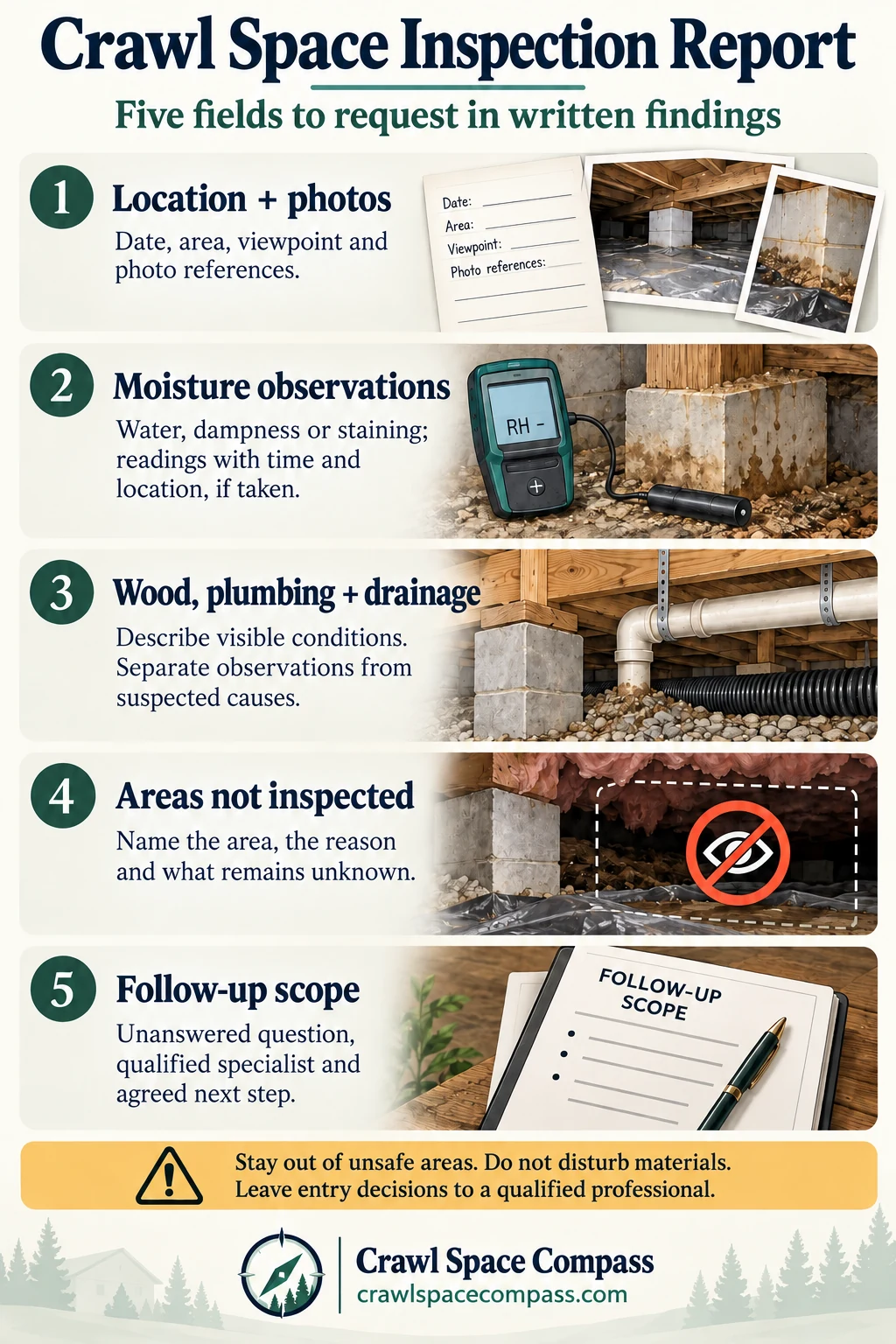
Text equivalent: Request five fields in written findings: location and photos, including date, area, viewpoint and photo references; moisture observations, including water, dampness or staining and the time and location of readings if taken; visible wood, plumbing and drainage conditions, separating observations from suspected causes; areas not inspected, why they were not inspected and what remains unknown; and follow-up scope, naming the unanswered question, qualified specialist and agreed next step. Stay out of unsafe areas, do not disturb materials and leave entry decisions to a qualified professional.
Common questions about orange drain deposits
Does orange staining prove the drain is blocked?
No. Ask what inspection or operating evidence establishes a restriction and where it occurs. Appearance alone does not answer whether water is being removed properly.
Is a bigger pump the answer?
The assessment should establish the problem first. Ask the bidder to explain why a different pump would address the documented finding and what happens to any restriction elsewhere in the system.
Can I use a farm-drain cleaning schedule for my crawl space?
No single schedule is established here. Request a plan based on the installed equipment, access, observed deposits and professional assessment. Agricultural examples are background evidence, not residential maintenance instructions.
The Indiana contractor directory is a starting point for service inquiries. Ask each company whether it investigates recurring drain deposits and can service your installed system at your address. A directory entry does not establish those capabilities.
Sources checked October 15, 2026. Purdue AY-300 is a June 2001 agricultural publication; the Reclamation page describes research funded in 2008–2009 and displays a June 2020 update. Fresh retrieval does not make those studies new. Equipment and source instructions should be rechecked when planning service. This guide is educational and does not identify substances or prescribe a site-specific repair.