
Does Crawl Space Encapsulation Help Indoor Air Quality?
Short answer: It can help control a moisture problem that contributes to poor conditions under your home. It does not, by itself, establish that the air upstairs is safe or that a health complaint will improve. A useful project combines moisture control with any needed cleanup, HVAC repairs, ventilation assessment, and separate radon and combustion-safety checks.
Last reviewed: October 3, 2026. Air-monitor guidance added October 9, 2026.
Encapsulation and indoor air: a visual planning checklist
Give each concern its own plan. Use this illustration to divide the proposal into clear responsibilities, then ask how each result will be checked.
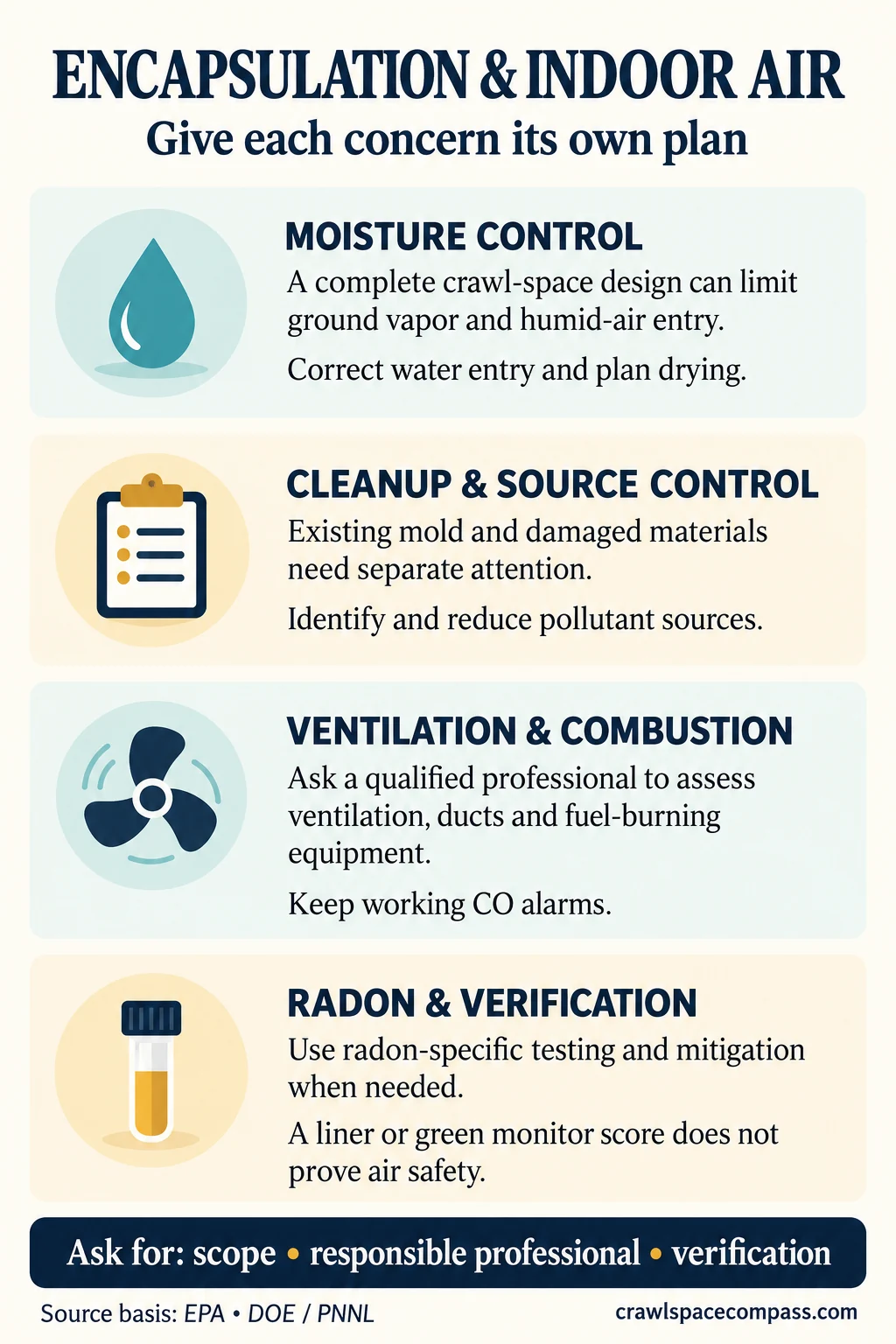
The graphic in text
- Moisture control: A complete crawl-space design can limit ground vapor and humid-air entry. Correct water entry and plan drying.
- Cleanup and source control: Existing mold and damaged materials need separate attention. Identify and reduce pollutant sources.
- Ventilation and combustion: Ask a qualified professional to assess ventilation, ducts and fuel-burning equipment. Keep working CO alarms.
- Radon and verification: Use radon-specific testing and mitigation when needed. A liner or green monitor score does not prove air safety.
Ask for: the scope, responsible professional and verification method for each concern. These are planning categories, not a required order of work or a health guarantee.
Graphic source basis, checked October 9, 2026: DOE/PNNL's crawl-space conversion checklist; EPA guidance on mold and moisture, source control and ventilation, monitor limitations and alarms, and radon testing and professional help.
The clearest benefit is controlling moisture
Soil vapor, outdoor humidity, plumbing leaks, and water entering after rain are different moisture sources. A ground liner limits soil evaporation. A complete closed-crawl design also addresses air leakage, insulation, and a planned drying method. DOE's Building America Solution Center explains that limiting humid outdoor air can reduce condensation on cool framing in suitable closed-crawl designs.
That matters because damp conditions can support mold. But installing a liner does not remove existing growth or repair damaged material. EPA's mold guidance calls for both addressing moisture and cleaning up mold. Ask the contractor to identify these as separate tasks rather than treating encapsulation as a substitute for remediation.
If water is entering, start with the drainage options guide. If growth or contaminated materials are present, use the crawl-space mold guide to prepare for a qualified assessment.
How can the crawl space affect air upstairs?
The crawl space and living area may be connected through floor openings, plumbing penetrations, and duct leaks. Airflow depends on the house and operating conditions; there is no fixed percentage of household air that can responsibly be assigned to every crawl space. DOE's crawlspace insulation background guide identifies penetrations and duct connections among important leakage locations.
A crawl-space moisture contractor and an HVAC technician may need to coordinate. Request an explanation of whether duct leakage, damaged duct insulation, or the home's pressure relationships need attention. A clean-looking liner is not evidence that duct problems have been corrected.
Air sealing also needs a ventilation plan. EPA identifies pollutant-source control, ventilation, and filtration as different approaches to indoor air quality. Removing water vapor does not replace those functions.
Match each claim to something you can verify
| Claim | Useful evidence | What it does not establish |
|---|---|---|
| The crawl is drier | Dated humidity and material-moisture records | All pollutants are controlled |
| The water problem is addressed | Documented source correction and checks after rain | The house cannot flood |
| Musty odor has decreased | A consistent household observation log | Medical improvement or radon safety |
| A specific contaminant is lower | Appropriate before-and-after testing interpreted for that contaminant | A universal air-quality certification |
Use this table to turn a broad promise of “healthier air” into a written scope with specific deliverables. If a seller cannot name the problem, method, and verification step, ask for a clearer proposal.
What can an air monitor prove after encapsulation?
If a contractor shows a green “good air” score, ask what the device actually measured. Relative humidity describes moisture conditions; it does not test for mold, radon or combustion gases. EPA explains that consumer monitors detect only the pollutants or conditions their sensors are designed for. Ask for the readings and units behind a combined score.
Interpret each measurement separately:
- Particles (PM): A particle reading does not measure gases or identify every particle present. Berkeley Lab's evaluation of seven consumer monitors found differing responses to residential sources, including missed sources dominated by ultrafine particles. These findings describe the tested devices, not every current monitor.
- Carbon dioxide (CO2): A reading can help assess ventilation when occupancy, outdoor concentration, elapsed time and other conditions are understood. NIST's CO2 guidance explains why a single universal value is not an overall indoor-air-quality test.
- Total volatile organic compounds (TVOC): A consumer TVOC total does not identify individual chemicals or establish that their concentrations are safe. Berkeley Lab's VOC-monitor explanation notes that sensors may respond to only part of the VOC mixture.
Ask for a measurement record, not just a screenshot
Our practical recommendation is to record the device model, measured parameter, units, location, dates and averaging period. Follow the manufacturer's placement instructions. For comparisons, use the same device and location over comparable recording periods. Note occupancy, cooking or cleaning, open windows and HVAC operation, plus temperature and humidity, which can affect some sensors. These details help a professional interpret a change; they do not establish that encapsulation caused it.
Keep this record alongside the crawl-space inspection report and the work-completion evidence. Certified CO and smoke alarms remain separate emergency safeguards; a general monitor's alerts do not replace them. Those PM, CO2 and TVOC readings also cannot replace radon-specific testing. Follow the radon test's own placement and timing instructions rather than general monitor advice.
Radon needs its own testing and mitigation plan
Radon is a naturally occurring radioactive gas that can enter through building openings. A humidity reading, lack of odor, or attractive liner cannot tell you its concentration in occupied rooms.
EPA's Consumer's Guide to Radon Reduction does not recommend sealing alone as a radon-control method. A crawl-space radon system may use a sealed membrane with a dedicated pipe and fan that draw gas from beneath it. That is a designed mitigation system, not simply an encapsulation package.
Discuss radon before work so testing and any needed mitigation can be coordinated with the liner. Plan follow-up testing after the crawl is closed, as described in DOE's pre-retrofit assessment guidance. Follow the test instructions and professional advice about placement and timing. EPA's radon testing and professional-finding resources connect homeowners with state programs.
Check fuel-burning appliances before changing airflow
A furnace or water heater that draws combustion air from its surroundings deserves attention before vents or other openings are sealed. Have a qualified professional evaluate combustion air, venting, and any required safety tests. Do not close openings or add fans around these appliances as a trial fix.
CDC explains that carbon monoxide is odorless and colorless and recommends working CO detectors near sleeping areas and annual qualified servicing of fuel-burning appliances. Encapsulation and a dehumidifier do not replace these safeguards. If a CO alarm sounds or poisoning is suspected, get everyone outside and contact emergency services.
A before-work worksheet for your household
Create one record you can share with each contractor. You do not need to enter a hazardous crawl space to complete it; request inspection photographs and readings from the professional.
- Problem and timing: Where do you notice odor or dampness? Does it follow rain, humid weather, heating, or cooling?
- Existing evidence: Save dated photographs, leak repairs, inspection findings, humidity records, and any previous radon results.
- Equipment: List HVAC equipment and fuel-burning appliances in or connected to the crawl. Note who services them.
- Household goal: Write a concrete building goal, such as resolving repeated duct condensation, rather than a medical outcome.
- Work sequence: Identify who will handle water entry, cleanup, damaged materials, duct work, encapsulation, and testing.
- Success criteria: Ask what will be measured, where, by whom, and when the contractor will return if the original problem persists.
Keep health questions with a clinician. CDC notes that mold affects people differently and does not recommend routine home mold testing. A generic mold sample should not become a promised diagnosis or proof that encapsulation will cure symptoms.
Questions to ask before signing
- What evidence connects the crawl-space condition to the problem we are trying to solve?
- Which moisture sources will this scope correct, and what is excluded?
- Who will inspect ducts, ventilation, and combustion equipment before and after the work?
- How will radon testing and any mitigation be coordinated with the installation?
- What products will be installed, and what installation-time ventilation or occupancy instructions apply?
- What maintenance, monitoring, and return visits are included in writing?
EPA's remodeling guidance emphasizes source control and ventilation together. Ask for that whole-house discussion even when the contractor's own work is limited to the crawl space.
Verify moisture control without overclaiming air quality
Keep before-and-after records from the same monitoring locations, with dates, temperatures, and weather notes. Review trends rather than comparing one wet summer afternoon with one dry winter morning. Agree on an operating target and response plan with the installer; our humidity guide explains how to organize readings.
At handoff, request photographs of completed work, equipment instructions, discharge locations, and the results of any agreed duct, combustion, or radon tests. Learn how you will notice a pump, drain, or dehumidifier problem. Set service intervals using the installed equipment's instructions.
If odor remains, reopen the investigation instead of simply lowering the humidity setting. Record which room, time, weather, and equipment operation coincide with it. Bring that information to the appropriate building or HVAC professional.
Finding help in South Carolina, North Carolina, and Georgia
Use our South Carolina, North Carolina, and Georgia directories to identify local crawl-space contractors, then verify the qualifications needed for your work. A directory listing is not a radon, HVAC, remediation, or medical credential. Compare responsibilities with the quote comparison checklist.
Frequently asked questions
Will encapsulation cure allergies or asthma?
No contractor should promise that result. Address documented building problems and discuss symptoms with a healthcare professional; those are separate decisions.
Does a dehumidifier clean the air?
Its central job is moisture removal. Do not treat it as a substitute for pollutant-source control, appropriate filtration, ventilation, or radon mitigation.
Can I skip radon testing if the liner is sealed?
No. A sealed appearance cannot establish the radon level. Use an appropriate test and qualified mitigation advice when needed.
Is closing the vents enough?
No. Vent closure belongs within a complete, appropriate crawl-space design. Water control, drying, equipment safety, and local requirements still need review.