
Is Crawl Space Encapsulation Worth It?
Short answer: Encapsulation can be worth considering when a documented moisture problem calls for a complete closed-crawl system and the proposal addresses its cause. It is harder to justify when the crawl is performing well or a targeted repair will meet the same goal. Decide from the condition, scope, ongoing responsibilities, and alternatives, not a promised resale premium or universal energy-savings percentage.
Last reviewed: October 3, 2026
First, define what the package includes
“Encapsulation” can describe different scopes. A proposal may include a sealed ground liner, wall or pier detailing, access-door improvements, air sealing, insulation, and humidity-control equipment. Drainage, mold cleanup, electrical work, and repairs may be separate. The project name does not tell you which problems the price covers.
DOE's closed-crawlspace guidance treats air sealing, moisture control, insulation, and conditioning as a coordinated design. Local requirements can also affect pest-inspection access, fire protection, and flood provisions. Ask how the proposed system fits your particular foundation rather than selecting a liner thickness first.
Use our encapsulation versus vapor barrier comparison to distinguish a ground-moisture measure from a broader conversion.
Which situation describes your crawl space?
| What has been observed? | What to investigate first | How encapsulation fits |
|---|---|---|
| Dry conditions, no recurring condensation | Whether any existing barrier or specific defect needs repair | Ask what additional, measurable problem a full conversion would solve |
| Persistent humidity or condensation | Ground vapor, outdoor air, leaks, and HVAC conditions | A coordinated closed-crawl design may be appropriate |
| Water after rain or a plumbing leak | The entry point, drainage, or plumbing failure | Address the source before covering the space |
| Mold or damaged wood | Cleanup needs, moisture source, and structural condition | Include required remediation or repairs in the sequence |
| Fuel-burning equipment, radon concerns, or flood exposure | Qualified safety and site-specific design review | Resolve these design constraints before committing |
These are decision prompts, not remote diagnoses. DOE's pre-retrofit assessment calls for investigating standing water, structural deterioration, equipment safety, and other hazards before work proceeds. Our drainage guide helps separate bulk-water work from humidity control.
A dry inspection on one day is useful evidence, but ask whether it represents the conditions that prompted the quote. A proposal should explain any uncertainty instead of treating an unobserved problem as established fact.
Encapsulation decision path
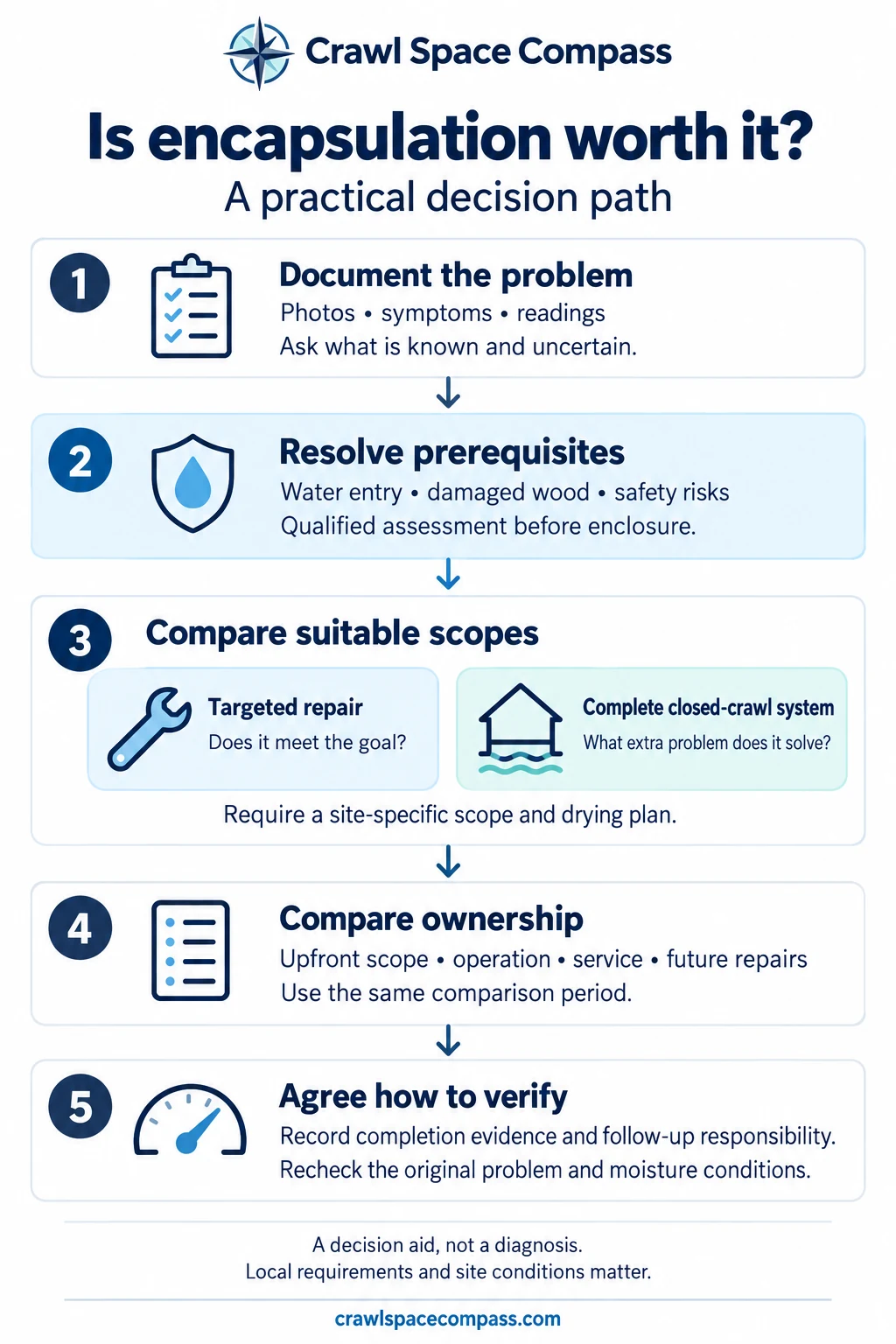
Full text version of the infographic
Crawl Space Compass
Is encapsulation worth it?
A practical decision path
- Document the problem
Photos • symptoms • readings
Ask what is known and uncertain. - Resolve prerequisites
Water entry • damaged wood • safety risks
Qualified assessment before enclosure. - Compare suitable scopes
Targeted repair
Does it meet the goal?
Complete closed-crawl system
What extra problem does it solve?
Require a site-specific scope and drying plan. - Compare ownership
Upfront scope • operation • service • future repairs
Use the same comparison period. - Agree how to verify
Record completion evidence and follow-up responsibility.
Recheck the original problem and moisture conditions.
A decision aid, not a diagnosis.
Local requirements and site conditions matter.
crawlspacecompass.com
Source notes: these comparison questions are an editorial planning aid. Technical background includes PNNL's pre-retrofit assessment, crawl-space water-management guidance, and closed-crawl-space guidance. Sources checked October 8, 2026.
Use this five-part decision worksheet
- Write the problem: “Condensation recurs on ducts during cooling weather” is more useful than “the crawl looks bad.” Attach photographs, reports, or readings.
- Name the cause and uncertainty: Ask what supports the diagnosis and what remains unverified. Require the contractor to distinguish observations from assumptions.
- Request realistic alternatives: Ask whether targeted drainage, plumbing, duct repair, or barrier repair could meet the goal. A phased plan should identify what is urgent and what can wait safely.
- Define completion: Agree on the deliverables and how the original problem will be checked after installation. Include who responds if it returns.
- Compare ownership burden: Decide whether the service access, equipment operation, maintenance, and monitoring fit what your household can realistically manage.
There is no meaningful universal score that converts these answers into a guaranteed return. If competing contractors disagree about the cause, a separate building-performance assessment can help you decide what to investigate before buying a large package.
Worked example: a targeted repair or full encapsulation?
Imagine a homeowner reports damp ground after rain and uncomfortable floors. One contractor proposes correcting an identified roof-runoff problem and repairing the existing ground cover while keeping the crawl space vented. Another proposes those repairs plus a sealed, insulated crawl space with a designed drying system. These are hypothetical proposals, not findings about your home. Neither option has yet demonstrated that it will meet the homeowner's goals.
Ask both contractors to separate the work they agree is necessary from the additional conversion work. Put the inspection evidence beside each recommendation. Our crawl-space inspection checklist can help organize the same observations for both companies.
1. Is the water source understood?
Rain-related dampness is a clue, not a complete diagnosis. Request the observed entry point, supporting photographs and the proposed correction. If water keeps entering or the source remains unclear, have the water-management scope reassessed before enclosure. Necessary leak, drainage and safety repairs should not wait for a decision about optional upgrades. PNNL's existing-crawl-space guidance places drainage and moisture correction before sealing and insulating.
2. What supports the additional conversion work?
Ask the second contractor which problem the smaller scope would leave unresolved and what evidence supports that conclusion. The conversion proposal should explain drying, insulation and air sealing together. PNNL's pre-retrofit assessment also identifies safety issues that need qualified attention before work proceeds, including deteriorated framing and combustion equipment.
If floor comfort or energy bills drive the extra work, ask whether a professional whole-home energy assessment would clarify the cause. DOE's assessment guide describes diagnostic testing and a findings report. The assessment may identify priorities elsewhere in the house; it does not establish a guaranteed saving from encapsulation.
3. What result would change the next decision?
Before choosing a scope, record who will check the repairs, under what conditions and who responds if dampness returns. For a completed conversion, include follow-up temperature, humidity and framing-moisture checks with a qualified professional. PNNL recommends post-retrofit monitoring; a dry-looking liner on installation day is not enough.
Copy this short decision record: observed problem; shared repairs; additional work and reason; unresolved questions; completion evidence; follow-up responsibility. A smaller scope needs evidence that it is adequate. A larger one needs evidence that its additional work serves this home's goals. Ask for a revised diagnosis or scope when either explanation is missing.
Example and linked source guidance checked October 8, 2026. This comparison is an editorial planning example, not a diagnosis or a prescribed construction sequence.
Compare the whole cost of owning the system
Use the same comparison period for each option, based on how long you expect to own the house or maintain the system. Enter actual written quotes and documented assumptions. Leave unknown costs visibly unknown rather than filling them with an online average.
| Cost category | What to request | Comparison check |
|---|---|---|
| Required preparation | Water correction, cleanup, disposal, and necessary repairs | Are all options solving the same existing problem? |
| Installed system | Measured coverage, materials, sealing, insulation, access, labor | Which items are included or excluded? |
| Equipment and installation | Exact pump or dehumidifier models, power, drainage, startup | Are electrical and discharge work priced? |
| Operation and service | Electricity assumptions, filters, inspections, cleaning, service fees | What changes with runtime and local utility rates? |
| Future repairs | Current replacement pricing and labor coverage | Which parts have different warranties or exclusions? |
Your comparison total is the upfront scope plus expected operating, service, and repair costs over that period. Keep required repairs separate from optional upgrades so the full package does not receive credit for benefits a smaller repair could also deliver.
For powered equipment, ask for an operating-cost estimate with its assumptions. A model's rated capacity alone is not an electricity bill. Do not subtract projected household energy savings unless the estimate is explained well enough to evaluate. Use our encapsulation cost guide to organize scope and our dehumidifier guide for equipment questions.
Keep energy savings and resale claims separate
A properly coordinated insulation and air-sealing project can improve thermal performance. DOE's crawlspace insulation background guide describes the importance of moisture management, airtight construction, and insulation together. It does not establish what your house will save.
If reduced bills are the main reason for the project, consider a qualified home-energy assessment first. DOE's consumer guide to energy assessments explains equipment-based evaluation and recommends preparing recent bills and a list of comfort problems. Ask the assessor to compare crawl-space work with other priorities.
Treat resale value as an unanswered local question rather than a line-item credit. Keep inspection reports, invoices, warranties, and maintenance records for a future buyer, but do not assume those documents guarantee a higher sale price. Ask a local real-estate professional about your market if an imminent sale drives the decision.
Questions that reveal whether the proposal fits
- Which observed condition makes you recommend full encapsulation here?
- What lower-scope alternative did you consider, and why would it fall short?
- Which water, mold, structural, HVAC, electrical, or pest-related work is excluded?
- How will you handle permits, inspection access, flood requirements, and equipment safety where applicable?
- What radon testing or mitigation coordination is needed?
- What measurements and photographs will I receive at completion?
- What does each warranty cover: materials, equipment, labor, access, or correction of the original problem?
- What recurring fees, transfer requirements, or owner maintenance conditions apply?
Existing mold needs its own appropriate response. EPA emphasizes cleaning up mold and fixing the water problem. A liner over unresolved conditions is not a complete scope. Radon likewise needs specific testing and, where needed, a qualified mitigation plan; EPA provides resources for finding testing and mitigation professionals.
Make the handoff part of the purchase
Before acceptance, request an installation record showing covered areas, access points, equipment models, discharge routes, and agreed test results. Have the installer explain normal operation, alarms, service needs, and who to call for a leak or failed unit.
Create a simple maintenance record using manufacturer instructions and the service agreement. Include liner and seam condition, drainage, pumps, condensate disposal, equipment servicing, and inspection access. Arrange qualified inspections rather than entering a crawl with standing water, damaged wiring, or other hazards.
Monitoring supports a decision to repair a problem promptly. It also gives you something more useful than a warranty headline: evidence of how the system is performing. Our humidity guide can help organize that record.
Compare local scopes in SC, NC, and GA
Find local options through our South Carolina, North Carolina, or Georgia directory. Ask each contractor to inspect the same issues and use the quote comparison checklist. Verify qualifications and written scope; a directory listing is not a guarantee of suitability.
Frequently asked questions
When might encapsulation be more than I need?
When the crawl is performing well or a documented problem has a suitable targeted repair. Ask what extra benefit the larger scope is expected to provide.
Will it pay for itself through energy savings?
There is no universal payback period. Require house-specific assumptions, include operating costs, and compare other improvements before relying on that claim.
Does a long warranty mean the whole system will last that long?
No. Read the coverage for each component and for labor. Warranty terms are not a prediction of equipment life or freedom from maintenance.
What if the crawl still has water after installation?
Document the condition safely and contact the responsible contractor. Reassess the water source and scope; a new liner does not make recurring water acceptable.