
Crawl Space Vapor Barrier Thickness: 6, 10, 12 or 20 Mil?
Compare crawl space vapor barrier thickness alongside product performance, installation details and future service access. A 20-mil label does not prove that a product meets the required standard, and a thinner sheet is not automatically suitable for every crawl space. Ask for the exact product data sheet and a complete installation scope before deciding.
Reviewed October 6, 2026. This guide helps homeowners compare material proposals. The local building official and project design determine the requirements for a particular home.
What does crawl space vapor barrier thickness mean?
A mil is one-thousandth of an inch. It is a thickness measurement, not a moisture rating or a predicted lifespan. Six mil equals 0.006 inch; 10 mil equals 0.010 inch; 12 mil equals 0.012 inch; and 20 mil equals 0.020 inch. Mil and millimeter are different units.
Two products with the same advertised thickness can have different construction, reinforcement and tested performance. Ask both installers to identify what the stated thickness measures and which current manufacturer document supports it. Use the same measurement basis when comparing proposals.
Vapor barrier thickness: a visual buying checklist
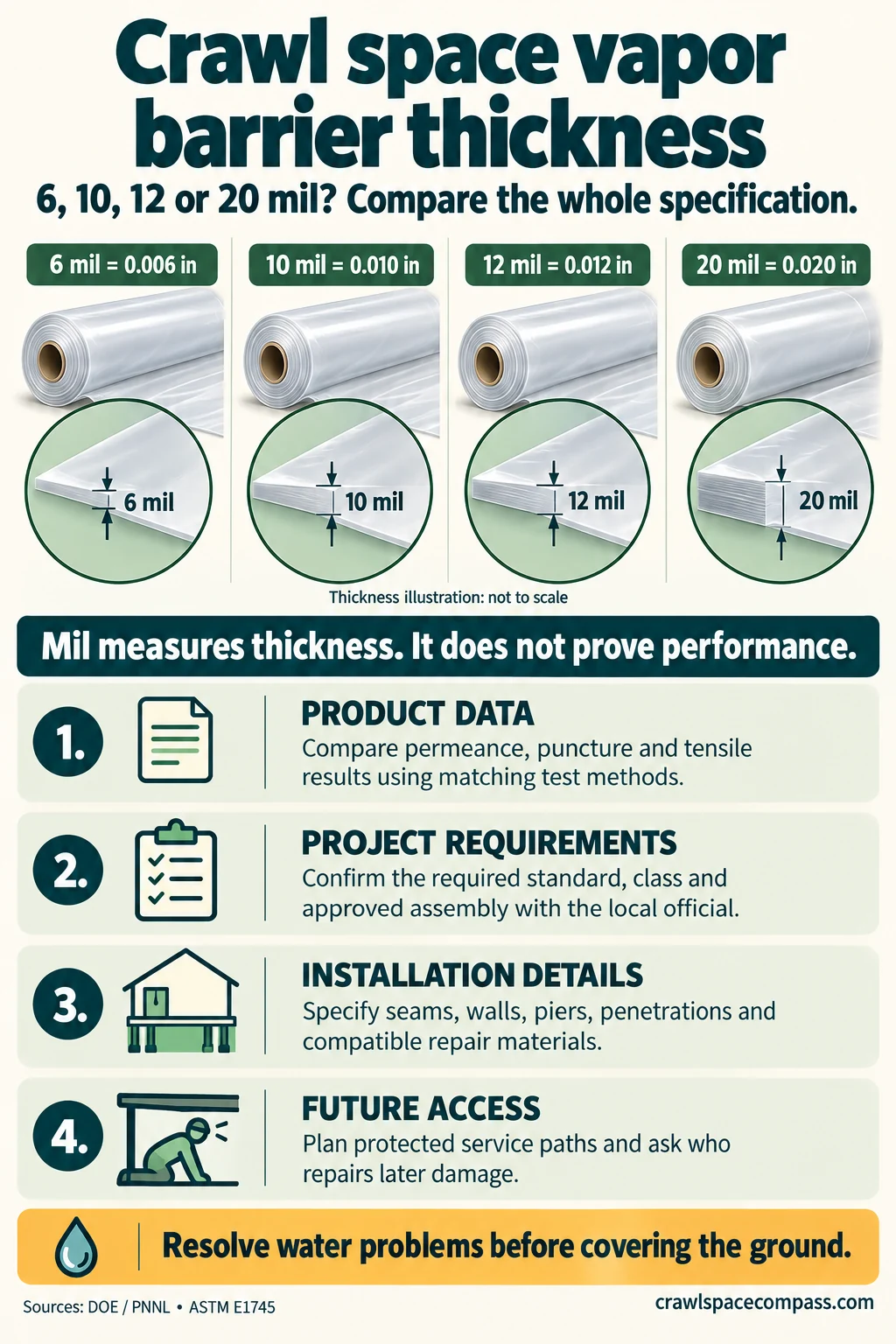
Use this graphic to keep four decisions together when comparing a liner. The enlarged drawings explain the labels; they do not show actual-size sheets or rank product quality.
Read the infographic as text
Crawl space vapor barrier thickness: 6, 10, 12 or 20 mil? Six mil equals 0.006 inch; 10 mil equals 0.010 inch; 12 mil equals 0.012 inch; and 20 mil equals 0.020 inch. The illustration is not to scale. Mil measures thickness; it does not prove performance.
- Product data: Compare permeance, puncture and tensile results using matching test methods.
- Project requirements: Confirm the required standard, class and approved assembly with the local official.
- Installation details: Specify seams, walls, piers, penetrations and compatible repair materials.
- Future access: Plan protected service paths and ask who repairs later damage.
Resolve water problems before covering the ground. Sources: DOE/PNNL ground-cover and water-management guidance, and ASTM E1745, linked in this guide.
How to compare 6-, 10-, 12- and 20-mil proposals
| Advertised thickness | Useful question to ask | What the number does not establish |
|---|---|---|
| 6 mil | Does this exact product suit the approved design, substrate and access needs? | Universal code compliance or resistance to future service damage |
| 10 mil | What tested performance and installation details justify this specification? | A particular ASTM classification merely because it is thicker than 6 mil |
| 12 mil | How does its product data compare with the other quoted liners? | An automatic performance improvement over every 10-mil product |
| 20 mil | Which documented properties or site conditions make this product appropriate? | Waterproofing, maintenance-free performance or a guaranteed service life |
The Building America Solution Center describes ground-cover assemblies using polyethylene at least 6 mil thick. That guidance also emphasizes continuity, sealed joints and protected service paths. It is a construction reference, not permission to use any 6-mil roll for every state code path.
If two quotes use different materials, ask for a same-scope alternative before comparing totals. Otherwise, the price difference may include drainage, wall coverage, access work or humidity equipment rather than just liner thickness.
A worked example: complete specifications versus a thickness label
This is an illustrative comparison, not a product test or an actual customer quote. Proposal A identifies a 10-mil liner and includes its current data sheet, claimed standard and class, seam method, perimeter attachments and protection along the service route. Proposal B says only “20-mil encapsulation liner.”
The missing information in B prevents a fair comparison. Ask for its exact product, documented performance and installation scope before judging the price difference. A is easier to review, but its documentation still needs to match the project's requirements. The example does not establish which thickness will perform better in your home.
- Make the materials comparable: request each product's permeance, puncture and tensile results, including methods, units and conditions. ASTM's water-vapor transmission standard cautions against applying a result from one test condition to another.
- Make the work comparable: align preparation, floor and wall coverage, seams, piers, penetrations, access protection and required repairs.
- Resolve gaps before choosing: record each missing item as “not specified.” Ask the installer to explain how the completed proposal meets the design and local requirements.
Keep the product comparison separate from the whole-project encapsulation budget. A thickness upgrade should not hide an excluded drainage repair or a different humidity-control scope.
Read the performance data, not just the mil label
ASTM E1745 covers sheet vapor retarders used against soil or granular fill under concrete slabs. Its classifications consider water-vapor permeance, tensile strength and puncture resistance, including specified conditioning tests. A code can reference that standard for another assembly. The thickness number alone does not demonstrate a classification.
Ask for these details in writing:
- Product identity: manufacturer, product name, thickness and current data-sheet revision.
- Vapor performance: reported permeance, test method and relevant test conditions.
- Strength: reported puncture and tensile results, with test methods and units.
- Classification: the exact standard and class claimed, with supporting documentation.
- Installation system: compatible seam tape, sealants, wall attachments and repair materials.
- Limitations: approved uses, substrate preparation, exposure restrictions and maintenance instructions.
Compare test results only when the methods and units are comparable. A large number in a sales brochure is not useful if one supplier reports a different test. Reinforcement is another product feature to evaluate, not a substitute for the relevant performance documentation.
Why the location and crawl-space design matter
For South Carolina unvented crawl spaces, the published R408.3 modification in regulation 8-1221 specifies a continuous vapor retarder meeting ASTM E1745 Class A. It also addresses sealed overlaps, attachment and moisture control. Simply writing “6 mil” or “20 mil” in a proposal does not answer that requirement. Confirm the applicable edition and details with the local official.
South Carolina code timing: as of October 6, 2026, the state's 2021 code cycle is the current statewide baseline. The Building Codes Council lists January 1, 2027 for implementation of the 2024 code cycle. Confirm the edition governing your project with the local building department, especially when planning work across that transition. Our crawl-space permit guide helps organize that conversation.
Elsewhere, ask which requirements apply to the actual assembly. A ground cover in a vented crawl space, conversion to a closed crawl space and a membrane below a concrete slab are different project descriptions. Do not borrow a slab requirement and assume it answers a crawl-space question.
Use our encapsulation versus vapor barrier comparison to identify the scope you are buying. Discuss wall insulation, pest-inspection access and any equipment changes before ordering materials.
Installation details that belong in every quote
A liner needs a prepared surface and a continuous, serviceable installation. Have the contractor explain what will be removed, which conditions must be repaired first, how the sheet will meet walls and piers, and how penetrations will be sealed. Ask who will photograph concealed details before the job is closed out.
Service access deserves its own line item. Where technicians must reach an air handler, plumbing or a pump, ask how the route will be protected and how future work will be repaired. The Building America ground-cover guidance includes protective runners or additional material along traffic areas as durability options. Use the chosen product's compatible repair method rather than assuming any tape will work.
Bulk water requires a separate plan. The Building America retrofit guidance calls for investigating water sources and managing drainage as part of the assembly. A heavy liner laid over an unresolved water problem is not a complete repair. See crawl-space drainage options for the questions to settle before installation.
A short liner-comparison worksheet
For each estimate, write down: exact product; stated thickness; applicable standard/class; floor and wall coverage; seams and attachments; pier and penetration treatment; access-path protection; preparation and drainage work; repair instructions; material warranty; installation warranty; and exclusions. Mark a blank item “not specified” instead of assuming it is included.
Then ask: “If the liner is punctured during future HVAC service, who repairs it, with what material, and at what charge?” A clear answer is more useful than a general promise that the liner is tough. Keep the product sheet, installation photographs and warranty with your home records.
Use the quote-comparison guide to compare the complete project. Browse companies listing vapor barrier installation, then confirm the company's scope, qualifications and availability for your address directly.
Check what you receive at completion
Request the installed product name and data sheet, photographs of seams and difficult-to-see details, compatible repair instructions, and separate material and workmanship warranty terms. Confirm that the supplied product matches the written specification. Ask the contractor to explain any substitution before accepting it.
Record a baseline of the finished condition and agree on follow-up checks after wet or humid weather. A clean-looking liner does not establish that liquid-water entry or humidity is controlled. Use the crawl-space humidity guide to understand readings, and arrange professional inspection if damage or damp conditions recur. Do not enter a crawl space with standing water, exposed wiring, contamination or unstable supports.
Common vapor-barrier thickness questions
Is 6 mil enough for a crawl space?
It appears in established ground-cover guidance, but “enough” depends on the exact product, approved assembly and durability needs. Confirm local requirements and the product documentation before treating it as compliant.
Is 20 mil always the best choice?
No single thickness answers every project. Compare documented properties, installation quality, access protection and the whole scope. A thicker label cannot make up for missing seams, poor attachments or unresolved drainage.
Can I put a new liner over the old one?
Have the old liner and the conditions beneath it inspected first. The Building America ground-cover guidance describes a second sheet after construction when the first is dry and free of organic matter. That example does not establish that every old liner can be covered. Wet debris, contamination, drainage or extensive damage may require a different plan.
Does a vapor barrier replace a dehumidifier?
It addresses ground moisture as part of a system. Whether additional humidity control is needed depends on the crawl-space design and conditions. See the dehumidifier guide before accepting equipment assumptions.
Compare the complete proposal
Carry the product and installation answers from the liner worksheet above into your full quote comparison. A thickness label alone does not establish that two bids include the same preparation, covered surfaces, seam details, repairs or warranty.
Compare written proposals side by side · Explore vapor-barrier companies