
How Long Does Crawl Space Encapsulation Last?
Last reviewed: October 3, 2026.
There is no single reliable lifespan for an entire crawl space encapsulation system. The liner, sealed joints, wall attachments, drainage and mechanical equipment need separate condition checks. A long material warranty does not establish how many maintenance-free years the installed crawl space will deliver. Decide whether to maintain, repair or replace it using inspection findings and the actual product documents.
This guide focuses on an existing system: what to inspect, which failures may be repairable, and what to ask before paying for replacement.
A visual checklist for crawl space encapsulation lifespan
Use these five checks to organize a condition assessment of an existing system. The illustrations are schematic reminders, not installation specifications, and they do not establish a replacement age.
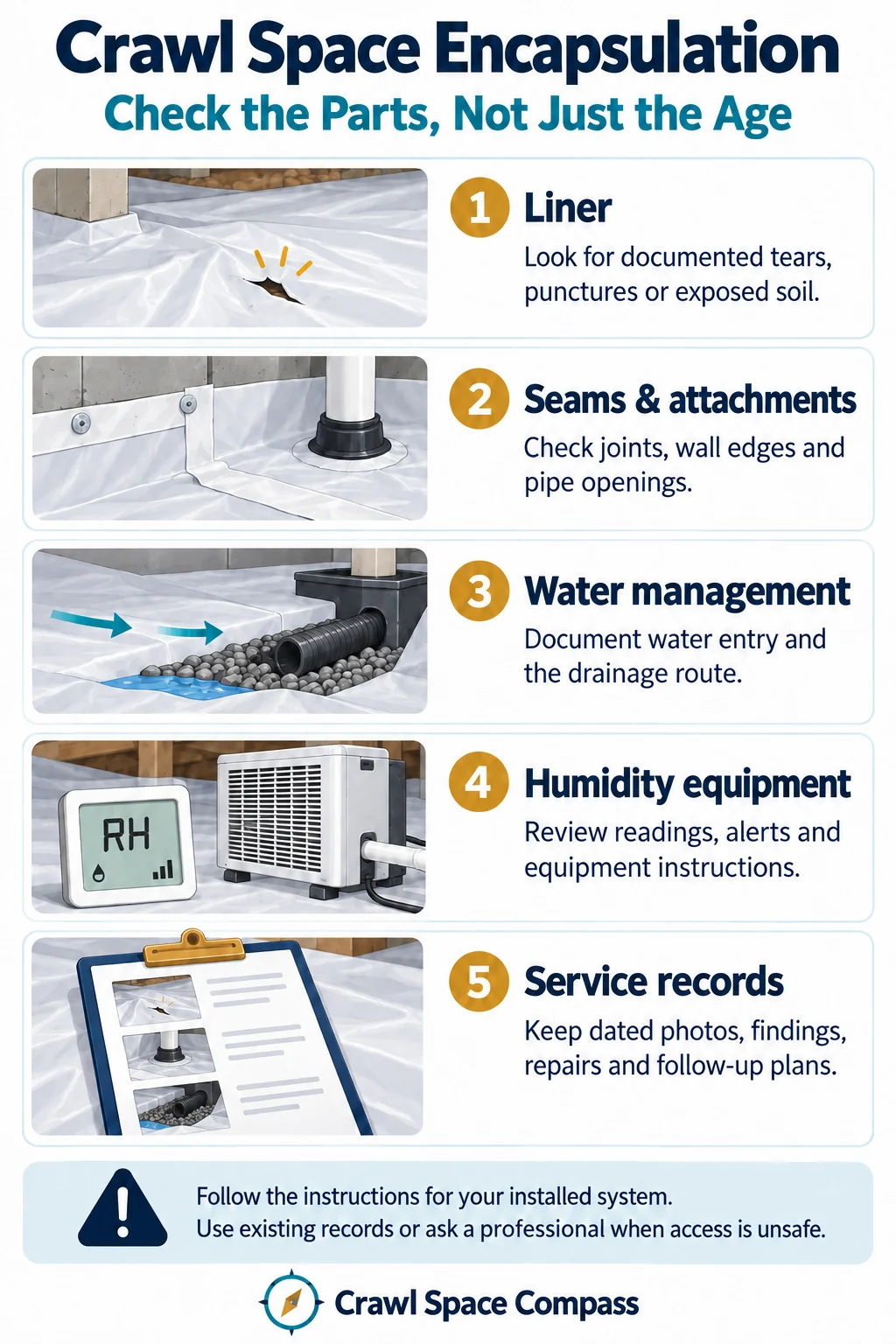
Read the infographic as text
Crawl Space Encapsulation: Check the Parts, Not Just the Age
- Liner: Look for documented tears, punctures or exposed soil.
- Seams & attachments: Check joints, wall edges and pipe openings.
- Water management: Document water entry and the drainage route.
- Humidity equipment: Review readings, alerts and equipment instructions.
- Service records: Keep dated photos, findings, repairs and follow-up plans.
Safety: Follow the instructions for your installed system. Use existing records or ask a professional when access is unsafe. Do not enter standing water or an area with suspected electrical hazards.
Visual source check: October 8, 2026. The component checks draw on PNNL water-management guidance and StegoCrawl's product-specific installation and repair instructions. Service-record prompts are editorial guidance. Neither source establishes one lifespan or maintenance interval for every installed system.
Separate the components before asking about lifespan
Start with an inventory. “Encapsulation” can describe different scopes, so the original proposal matters more than the label on the sales brochure.
- Ground and wall liner: identify the manufacturer, product and thickness. Record exposed soil, punctures, torn corners and areas disturbed by later work.
- Seams and attachments: check whether overlapping sheets, pier details, penetrations and wall terminations remain continuous and secure.
- Water management: document any installed drains, sump basin, discharge route and alarms. These need their own inspection.
- Humidity-control equipment: keep the dehumidifier model, serial number, manual and service history separate from liner records.
- Insulation and access details: note damaged insulation, a poorly fitting access door or changes around equipment and pipes.
A dehumidifier that needs service does not by itself establish that the liner needs replacement. Likewise, intact-looking plastic does not prove drainage or humidity control is working. Ask the inspector to identify each problem by component and location.
What determines whether the system keeps working?
Unresolved water entry deserves priority. DOE's crawl-space water-management guidance calls for addressing drainage and moisture problems before sealing and insulating. If water keeps entering an existing installation, investigate its pathway before covering the area with another layer. Review the separate drainage options guide when rainwater or groundwater is involved.
Installation details also matter. As one product-specific example, StegoCrawl's installation instructions specify sealed seams and penetrations plus attachment at foundation walls. Those details help explain why an inspector should examine more than the broad, undamaged center of a sheet. Follow the instructions for the product actually installed; this example is not a universal specification.
Thickness alone cannot provide a service-life estimate. Ask for documented puncture resistance, vapor permeance and installation requirements rather than treating a mil rating as a number of years. The manufacturer's current 15-mil data sheet, for example, reports those properties separately and calls for inspection and repair of visible damage.
Read the warranty as a coverage document
Keep the material manufacturer's warranty and the installer's workmanship warranty. Ask for the version that applies to your purchase, with these points highlighted:
- Covered item: does the document cover the sheet, installation labor, seams, equipment or a defined combination?
- Covered failure: what must happen for a claim to qualify?
- Remedy: does coverage provide replacement material, a refund, labor or removal and reinstallation?
- Conditions: what inspection, servicing, documentation or notification is required?
- Exclusions and transfer: what happens after a flood, physical damage, later trade work or a home sale?
For a concrete example, StegoCrawl's limited warranty, revised July 22, 2026, uses “Life of the Building” language but defines the covered product, conditions, exclusions and remedy. It excludes specified installation and later-work damage; its stated remedy is product replacement or a purchase-price refund at the manufacturer's option. That document does not establish the service life of a complete encapsulation system. Other products and installers have different terms.
Build a maintenance record you can actually use
At handover, request dated photographs, product labels, equipment manuals, the drainage layout, baseline humidity readings and a written service schedule. If you bought the home later, gather whatever records exist and have an inspector document the starting condition.
Follow equipment and installer instructions for routine checks. Between service visits, a remotely readable humidity sensor can help you notice changes without entering the crawl space. A rising reading is a reason to investigate, not proof that one particular component failed. Our humidity guide explains how to interpret readings.
- After significant rain or a water alarm, arrange a check for new water entry and drainage problems.
- After plumbing, HVAC or pest work, request photographs of affected liner and access areas.
- Record equipment alarms, unusual operation, service dates and any changes in smell.
- Have filters, condensate disposal and pumps checked as their manuals require. Do not improvise electrical or pump repairs.
This is a practical recordkeeping plan, not a universal annual maintenance standard. Agree on the inspection cadence with the installer and equipment service provider. Use the crawl-space inspection checklist to request documentation when access is unsafe or difficult.
Compare a maintenance plan with the work your system needs
Before buying a recurring service plan, ask each provider to price the same component checklist. An “annual inspection” might document conditions without cleaning equipment or repairing the liner. A dehumidifier service visit might leave seams, drainage and access details outside its scope. Ask what happens during the visit, rather than comparing plan names alone.
Product instructions help define the work. For example, Stego recommends yearly checks of its liner seams and perimeter edges, with repair or resealing as needed. AprilAire identifies filter and drain cleaning for its E070, E080, E100 and E130 dehumidifiers and directs owners to the model manual. These examples do not establish a universal schedule or a requirement to buy a paid maintenance contract.
- Covered tasks: List the liner, seams, attachments, equipment, condensate route and any pumps or alarms. Mark each task as inspected, cleaned, tested, repaired or excluded.
- Timing and responsibilities: Identify the applicable product instructions, visit frequency and any checks needed between visits. Ask who handles work the homeowner cannot safely perform.
- Included cost: Separate the visit fee from filters, repair materials, parts, labor, travel and extra callouts. Ask whether a finding produces a repair or only a separate estimate.
- Evidence and follow-up: Request dated photographs, readings, completed tasks, inaccessible areas and the next service date. Clarify who responds to an alarm or a recurring problem between visits.
- Coverage conditions: If the provider says a plan protects a warranty, ask for the specific document and condition, plus the service records you must keep.
For equipment work, start with the dehumidifier service checklist and listings; for liner work, use the vapor-barrier checklist and listings. Confirm that a provider services existing installations, your equipment model and your address. A service label does not confirm those capabilities.
Maintenance-plan guidance checked October 11, 2026. The comparison questions are homeowner planning prompts; manufacturer examples are product-specific and are not endorsements.
Turn a new problem into a useful service request
Describe what changed before asking for a replacement quote. Use existing photographs and remotely available readings, or ask a professional to document inaccessible areas. Do not enter a crawl space with standing water, suspected electrical hazards or unsafe access to complete this record.
- A tear, open seam or loose attachment: record its location and approximate extent if already documented. Ask whether the surrounding material remains serviceable, which repair suits the installed product, and what could damage the same area again. A product's repair instructions matter more than choosing tape by appearance.
- Water following rain: give the date, affected location and whether it recurs. Request a review of the water source and drainage route before treating a liner patch as the complete solution. The after-rain guide explains what to document safely.
- Rising humidity without obvious liner damage: send dated readings, sensor location and equipment alerts. Ask the service provider to assess moisture sources, air sealing and drying equipment. A humidity change alone does not identify the failed component.
- A problem noticed after plumbing, HVAC or other work: include the work date and affected area. Request a review of disturbed seams, attachments and new penetrations without assuming who caused the problem. Ask which provider will restore any affected encapsulation details.
Example service brief: “After plumbing work beside the access opening, the completion photo shows an open liner seam. Please assess that area, identify the installed liner, explain the compatible repair and check nearby penetrations. Please separate this work from any broader replacement recommendation and provide photographs when it is finished.” This is a hypothetical request, not a diagnosis or a standard repair specification.
Agree on the follow-up before work starts
Ask the contractor to complete the same short record for each diagnosed problem:
- Finding: location, dated photograph or reading, and the assessed cause.
- Work: what was repaired, what was retained, and the materials or equipment used.
- Check: before-and-after photographs and the operating checks or moisture readings taken.
- Follow-up: who will recheck it, under what conditions, and whom to contact if the symptom returns.
If water appeared only after rain, ask when a comparable rain event should trigger another check. A dry photograph on repair day cannot establish performance in wet weather. Retain the service report with the original installation documents so the next provider can see what changed.
Checklist source check: October 8, 2026. These homeowner questions apply the separate repair, water-management and monitoring principles in the StegoCrawl installation instructions and PNNL's water-management and unvented crawl-space guidance. Product examples are not endorsements; follow the instructions for the actual system.
When does repair make sense, and when is replacement worth evaluating?
Ask about localized repair when damage is limited and the surrounding assembly is sound: a puncture from service work, a detached section or an accessible failed seam. Have the installer confirm compatible repair materials and preparation. The Stego data sheet linked above permits repairs with specified accessories for that product; use your own manufacturer's requirements.
Request a broader assessment for widespread damage, repeatedly failing repairs, extensive missing coverage, persistent water entry or an installation whose details cannot be corrected reliably. Ask for photographs showing why replacement is recommended and which underlying conditions will change.
New staining, damp framing or a musty smell calls for investigation before the area is concealed. EPA's mold and moisture guidance emphasizes correcting moisture problems alongside cleanup. A replacement liner alone cannot establish that affected materials have been addressed.
Ask for a component-by-component repair quote
Have the contractor price the diagnosed work, not just a new “system.” Request separate descriptions of reusable components, damaged material, water-control corrections, equipment service and cleanup. Ask what evidence would justify expanding the scope after work begins.
Before accepting a full replacement recommendation, ask: What failed? Where is the evidence? Can it be repaired? What will prevent the same problem from returning? Which warranty applies afterward? Use the crawl-space quote comparison guide to compare proposals on the same scope.
Frequently asked questions
Does encapsulation last 20 years?
A 20-year claim needs a defined component, product and basis. The sources reviewed for this guide do not establish a universal 20-year service life for complete installed systems. Evaluate the actual installation and its written coverage.
Does an old liner automatically need replacement?
No fixed replacement age follows from this review. Ask for a condition assessment, including seams, attachments and water management, before deciding.
How long will the dehumidifier last?
There is no model-independent answer here. Follow its manual and warranty, and have performance problems diagnosed separately. See the dehumidifier guide for service and selection questions.
Is a longer warranty always the better offer?
Compare covered failures, remedy, labor, exclusions and service obligations as well as duration. A longer headline alone leaves important questions unanswered.
About this guide: Primary-source links were checked October 3, 2026. Manufacturer examples illustrate documentation, not endorsements. Inspection and purchasing questions are editorial guidance; no fixed service life, energy saving or maintenance-free performance is promised.