
Before buying crawl space insulation or encapsulation in Huntsville, ask what is causing the uncomfortable rooms above it. A useful starting point for Huntsville Utilities customers is the utility's home energy survey. Use the findings to request separate explanations for duct repairs, air sealing, insulation and moisture work, then compare proposals against the same observed problems.
This guide is for homeowners considering comfort or efficiency improvements in Huntsville, Alabama. It does not assume that every cold floor needs a closed crawl space, or that a utility survey includes every diagnostic test your house may need.
Start with Huntsville Utilities' energy survey
The city identifies Huntsville Utilities as a city-owned authority. Its Home Energy Inspection Services page describes an on-site survey with a report of recommended efficiency improvements. Listed components include reviewing duct condition and airflow, air leaks, HVAC equipment and attic insulation. The page says there is no fee for this service.
When requesting the visit, explain that your concern is the crawl space and the rooms above it. Ask whether access conditions allow the relevant areas to be reviewed and whether any additional testing needs a separate appointment. A listed airflow review does not tell you that a particular duct-leakage test is included.
Prepare a short room-by-room account: where floors feel cold, which rooms are difficult to heat or cool, whether the issue changes with weather, and what recent HVAC or insulation work has occurred. Bring existing contractor proposals. Ask the adviser to identify which recommendations need a specialist's investigation before you choose a project.
Ask bidders to separate three jobs
Convert the survey findings into a list that each bidder can answer. Keep these parts visible in the scope:
- Duct system: which supply or return sections need testing, connection repairs, support, sealing or insulation?
- House boundary: where are air leaks between the home and crawl space, and which surfaces will be insulated?
- Crawl-space moisture: what water sources or damp materials must be addressed, and how will the finished space be monitored?
For example, a hypothetical proposal might replace floor insulation while leaving damaged duct connections outside its scope. Another might include those repairs and change the crawl-space enclosure. Ask each company to explain how its proposed work addresses the documented room complaint. Matching square footage alone will not make those proposals comparable.
Request labeled inspection photographs and a sketch showing the work areas. If part of the crawl space could not be inspected, have that limitation written into the proposal rather than treated as an assumed condition.
Give duct problems their own inspection
The Building America pre-retrofit guidance recommends testing ducts for airtightness and checking their insulation, installation and support when they will remain in a vented crawl space. Ask the HVAC contractor which checks fit your system and what results you will receive.
If droplets or wet duct insulation are also present, document when and where they appear. Ask the contractor to distinguish condensation, equipment drainage and other water sources. Our crawl space duct condensation guide explains the observations to take to that visit.
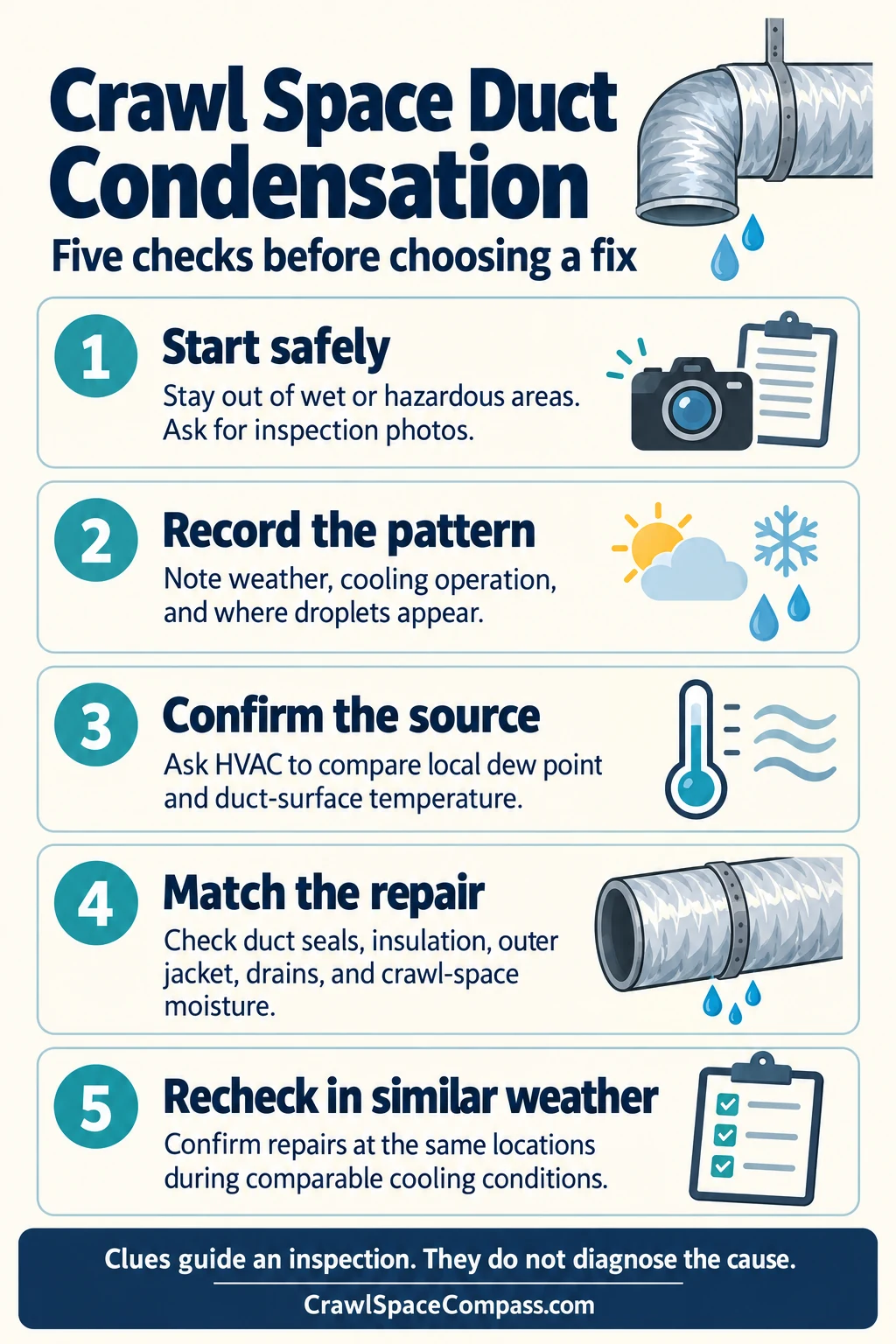
The checklist's sequence is simple: stay out of hazardous areas, record the weather and cooling pattern, have the source assessed, match repairs to the findings, and arrange a recheck under comparable conditions. Photos of new insulation alone do not document whether a duct-performance complaint was resolved.
Make the insulation location explicit
The Department of Energy's floor-insulation guidance explains that insulation above unconditioned space needs continuous contact with the air barrier. It also calls for addressing holes around wiring and plumbing before insulating. Ask the installer to show how the proposed assembly will be supported and how gaps will be addressed.
If the proposal moves insulation to the foundation walls, ask for a coordinated description of the ground liner, vents, access opening and drying approach. Have the contractor explain what happens to existing floor insulation. Specify the product, location and intended installed performance instead of accepting only a package name.
Before air sealing, have a qualified professional evaluate any fuel-burning appliance's venting and combustion-air needs. Building America's assessment also calls for resolving water sources and unsafe electrical conditions before retrofit work. Keep these evaluations in the project sequence and identify who is responsible for any required building or trade approvals.
Verify program eligibility before relying on an incentive
Huntsville Utilities also links customers to TVA EnergyRight. On its insulation and air-sealing program page, EnergyRight says rebate-eligible work must be performed by a Quality Contractor Network member and meet the standards effective on the installation date. It describes the contractor submitting the rebate request after the upgrade.
Before signing, ask whether your exact measure, property and selected contractor qualify. Get the answer for the proposed floor or wall assembly, rather than assuming all work sold as encapsulation receives an incentive. Keep the full contract price and any expected rebate separate so you can see what you would owe if the incentive is unavailable.
Compare the findings, scope and completion evidence
For local starting points, the directory includes Crawlspace Medic of Huntsville and Precision Crawlspace & Renovations. Confirm current service coverage and the work each company actually performs. A directory listing does not establish TVA network participation or replace checking the appropriate trade credentials.
Ask each bidder these questions before choosing:
- Which inspection finding supports each item in the proposal?
- Who handles duct testing and repairs, and are their results included?
- Which water or safety conditions must be resolved before insulation?
- What work is excluded, and how will concealed conditions be priced?
- What photographs, product records and follow-up measurements will I receive?
At completion, keep the original survey, agreed changes and closeout records together. If the original room complaint continues, that record gives the next service visit a concrete starting point.
Source review: October 14, 2026. Utility services and incentive requirements can change. Confirm current availability and project eligibility directly with the program before committing to work.