
If water appears beneath a Savannah home while the air conditioner is running, ask an HVAC professional to trace the condensate route before choosing a crawl-space waterproofing package. Document where the water was seen, what the equipment was doing and which parts of the system were actually inspected. A moisture-repair plan needs a clear handoff between the equipment work and the crawl-space work.
This guide covers homes within the City of Savannah, Georgia. A Savannah mailing address does not establish which permitting office serves a property. Confirm the jurisdiction before using the city’s inspection process. Do not enter a wet or otherwise unsafe crawl space, open electrical equipment or disconnect a drain to investigate.
Identify equipment water before assigning a drainage repair
The U.S. Department of Energy’s pre-retrofit assessment guidance identifies equipment condensate as one possible interior moisture source in crawl spaces. It also identifies plumbing leaks and exterior water. The guidance calls for water sources to be investigated and corrected before air-sealing and insulation work proceeds.
For a homeowner, the useful first step is a timeline, not a diagnosis. Was the cooling system operating when water was noticed? Had it recently rained? Was there an equipment alarm or a service visit? Did an inspector see water coming from a component, or only a wet patch below it? A patch near an air handler can justify a closer look without proving which component is responsible.
Keep three observations separate: water inside or escaping from the condensate collection route, droplets on the outside of cold ducts, and water entering from the surrounding site. The duct-condensation guide addresses the second issue. Several sources may exist together, so a repaired equipment drain does not automatically resolve rain-related water.
Ask the HVAC contractor to document the whole route
ENERGY STAR’s maintenance checklist includes inspecting the condensate drain and checking that equipment starts, operates and shuts off properly. It notes that a plugged drain can cause water damage and affect indoor humidity. Use that as a starting point for a service request rather than asking only whether the air conditioner still cools.
Ask the technician to explain the route from the equipment’s collection point to its final discharge. Have the report identify the equipment served, accessible drain sections, any pump, and the outlet. If a route is concealed or cannot be followed, record that limitation and the proposed next check.
- Observed defect: What actually leaked, overflowed or failed during the assessment? Which explanation remains unconfirmed?
- Repair: What was cleaned, repaired, replaced or rerouted, and why?
- Protection: What overflow protection is present, and how was its operation evaluated for this equipment?
- Destination: Where does the water discharge, and who confirms that arrangement is suitable for the property?
- Evidence: What operating checks were completed, under what conditions, and what photographs or notes will be supplied?
Do not bypass a shutoff or alarm to keep cooling. Ask the servicing professional what to do if it activates again. This guide does not prescribe drain dimensions, chemical cleaners, equipment controls or a discharge connection; those choices depend on the system, manufacturer instructions and applicable local requirements.
Use Savannah’s mechanical-inspection route when the work needs it
The City of Savannah Inspections page explains that Development Services reviews plans, issues permits and inspects building systems, including heating and air conditioning. It publishes a separate mechanical-inspection contact and asks callers to have the permit number and job address available.
Before approving equipment relocation, replacement or a broader drain-routing change, ask the contractor which permit or inspection questions apply to the exact scope. Give Development Services the address and a plain description of the proposed work if clarification is needed. A maintenance checklist is not a permit determination, and a permit for a different project does not document this repair.
Keep any permit number and inspection result with the HVAC service report. For a property outside the city, use the authority responsible for that address. This guide does not extend Savannah’s procedures throughout Chatham County.
Treat the discharge destination as part of the repair
Savannah’s Water Saving Tips page discusses collecting AC condensate for garden use and avoiding water that remains in a collection container. That conservation suggestion does not approve a particular equipment-drain alteration or a container placed beneath a house.
If a contractor proposes an outdoor outlet or a collection arrangement, ask where overflow goes, how the route stays accessible and who maintains it. A useful sketch shows the outlet in relation to the foundation, access door and walking routes. Ask the professional to explain how the destination avoids creating a new recurring wet area.
If the proposed solution also involves excavation near trees, review the separate Chatham County drainage and tree-protection guide. That guide distinguishes county resources from the Savannah review path. Do not assume a small equipment drain authorizes unrelated trenching or changes to another drainage system.
Give the crawl-space contractor a precise handoff
After the HVAC assessment, separate the equipment correction from any remaining building work. Ask the crawl-space contractor to document affected insulation, liner condition, visible wood conditions and areas still inaccessible. Request an explanation of what must be dried, repaired or evaluated before new materials are installed.
For example, a useful record might say: “Technician repaired a separated condensate connection; the rear insulation bay remains wet; crawl-space contractor to assess that bay and document the drying or replacement scope.” This is a hypothetical example. It avoids turning one completed service call into an unsupported statement that the entire crawl space is ready for enclosure.
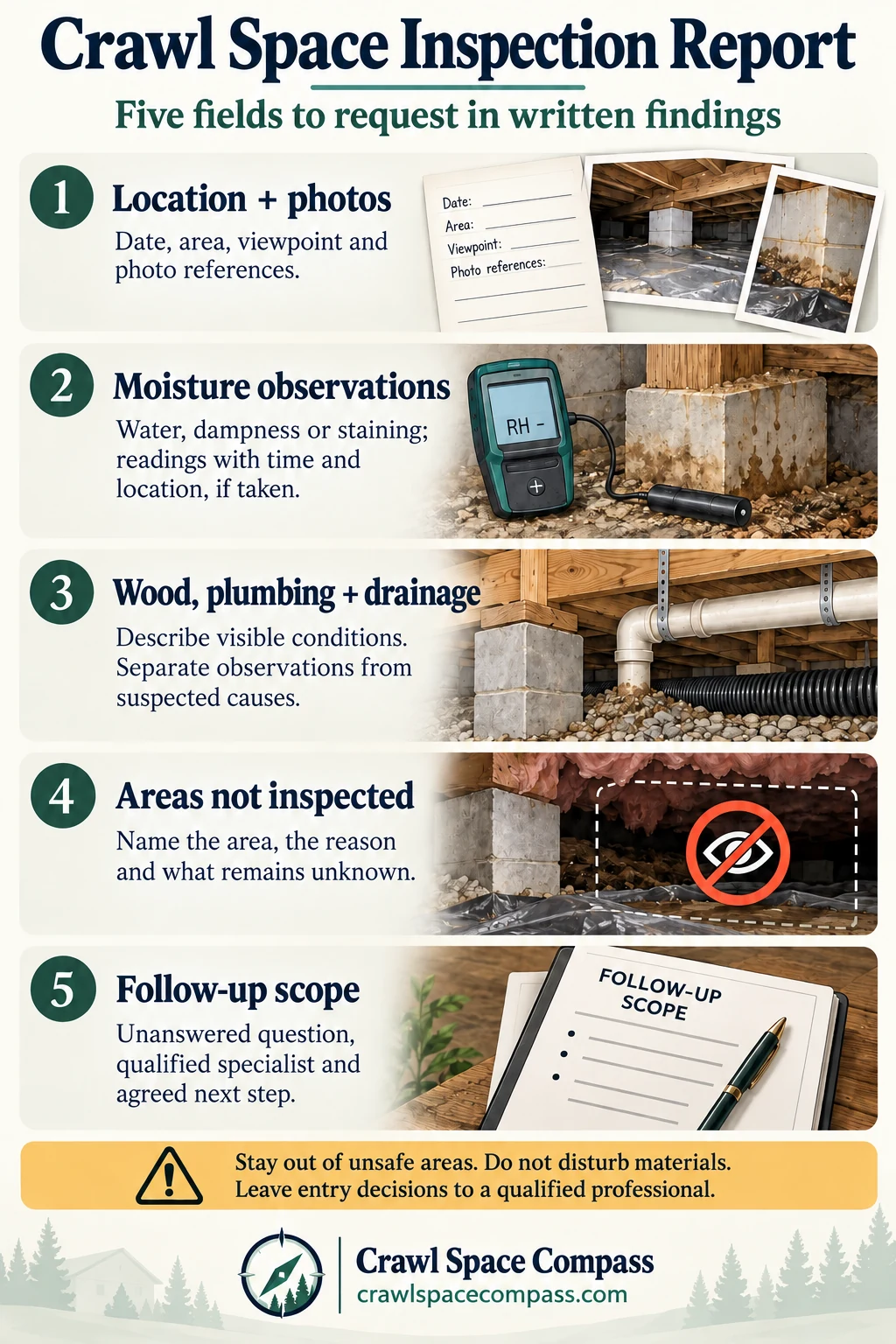
Inspection report graphic, in text
Crawl Space Inspection Report. Five fields to request in written findings:
- Location + photos: Date, area, viewpoint and photo references.
- Moisture observations: Water, dampness or staining; readings with time and location, if taken.
- Wood, plumbing + drainage: Describe visible conditions. Separate observations from suspected causes.
- Areas not inspected: Name the area, the reason and what remains unknown.
- Follow-up scope: Unanswered question, qualified specialist and agreed next step.
Safety: Stay out of unsafe areas. Do not disturb materials. Leave entry decisions to a qualified professional. Graphic: Crawl Space Compass, crawlspacecompass.com.
Compare local moisture-work options
Use the Savannah crawl-space directory and Georgia contractor guide for the building side of the project. Healthy Crawlspace advertises Savannah crawl-space work including encapsulation, drainage, vapor barriers and dehumidification. Clark Clean lists Savannah service and advertises water-damage restoration and crawl-space encapsulation.
These profiles are research starting points, not endorsements or verification of HVAC licensing. Confirm service at your address and the specific scope. An offer of duct cleaning does not establish that a company will repair the air-conditioning condensate system. Ask who takes responsibility for that work and whether it is included in the price.
Common questions
Will a dehumidifier fix a leaking AC drain?
Ask for a repair to the identified equipment defect and a separate explanation of any remaining humidity-control need. A proposal should identify the problem each component is intended to address.
What if water returns only after rain?
Update the timeline and share it with the inspecting professionals. The equipment repair may be complete while a separate water-entry question remains open. Keep both findings in the project record.
What belongs in the maintenance handover?
Request the equipment and drain-route identification, service instructions, safe homeowner observations, alarm response, next professional check and contact for recurring leakage. Preserve access to service points when later crawl-space work is planned.
Source review: October 15, 2026. Savannah, ENERGY STAR, DOE and company-published service pages were reviewed. This is an editorial planning checklist, not an equipment diagnosis, repair design or address-specific permit decision.